
LATEST STORIES:

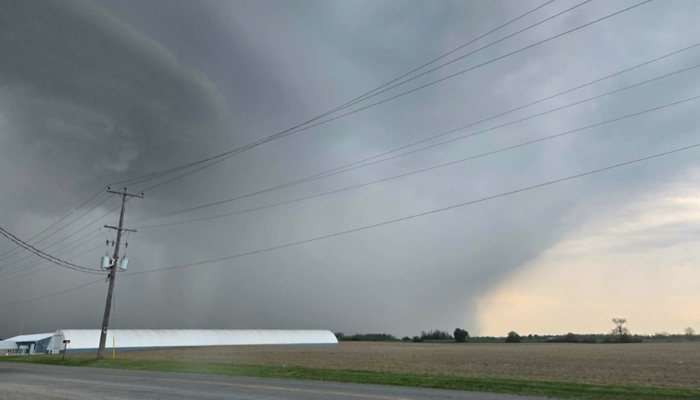
A major cleanup is underway after wild and dangerous weather roared through the region, toppling trees and power lines. And while the Hamilton area mostly experienced heavy rain and winds, officials now confirm a tornado touched down just west of the city in London.
Environment and Climate Change Canada reported that wind gusts hit around 90 km per hour in the London area, while the strongest wind report in Hamilton was an 80 km per hour gust recorded at the airport.
Closer to home, the City of Hamilton received nearly 70 calls for service regarding downed trees and power. City officials said they responded to 34 service calls overnight and 33 more during the day, with more expected as residents survey the aftermath.
Chantal Bourque was one of many Hamiltonians assessing the damage after heavy rain and strong winds gusted through the city. A massive branch from her neighbour’s old tree came down in her backyard in the city’s north end, causing minor damage to her garage but leaving the house she has shared with her sister for the past five years completely fine. No injuries were reported.
“The wind was pretty bad, we felt the whole house shake,” Bourque said. “Now that I’m thinking about it, maybe that was the tree falling. But yeah, we could feel the upstairs shaking, so it was pretty intense wind.”
Bourque said she and her sister were watching television when they received a phone call from their neighbours.
“All I heard was ‘yup okay, I’ll be out back.’ And I said ‘what happened’ and she said ‘the tree fell down.’ I was like ‘oh, you mean the fence?’ And I came out like nope, the tree,” Bourque said.
Bourque is now waiting for her landlord to deal with the branch, which she described as big enough to be an entire tree itself.
READ MORE: Local cleanup begins after severe thunderstorm rips through southern Ontario
The damage was not isolated to the north end, as tree limbs also came down in Victoria Park and Dundas.
However, Hamilton did not deal with the worst of the storm. Tornado sirens went off on Western University’s campus in London, which is home to the Northern Tornadoes Project, a group that investigates weather patterns and damage to determine if a tornado has actually occurred.
David Sills, the director of the Northern Tornadoes Project, explained the difference between storm types.
“A tornado is usually a long, narrow path of damage. And with a downburst, it’s usually over a wider area,” Sills said.
Officials say at least one twister touched down southeast of London, and unconfirmed images showed a funnel cloud in the area. The team is continuing to analyze the details to characterize the strength of the storm.
“We rate the damage on the Enhanced Fujita scale that goes from zero to five,” Sills said. “I doubt anything will get past zero from yesterday, even though it affected a lot of people, it was fairly weak damage. We’ve seen a lot worse.”
According to the Northern Tornadoes Project, this marks the second recorded tornado in Ontario this year, following a May 7 event just north of London.
Monica Vaswani, a warning preparedness meteorologist with Environment and Climate Change Canada, noted that the strongest wind report she was able to find in the Hamilton and Niagara region was at the Hamilton airport.
“There was a gust of about 80 km per hour, which is still very strong,” said Vaswani.”
While officials say it is difficult to predict whether the region will see more tornadoes this year, severe thunderstorms remain common. Environment Canada recommends that residents put together an emergency kit to prepare for these situations.
READ MORE: Environment Canada tracking severe thunderstorm across southern Ontario