LATEST STORIES:

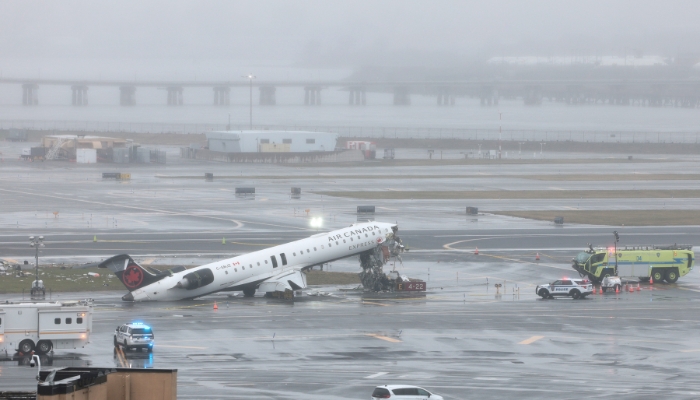
The U.S. National Transportation Safety Board (NTSB) released its preliminary report Thursday into the deadly crash between an Air Canada jet and a fire truck at LaGuardia Airport in New York.
The report on last month’s crash says a firefighter on the truck heard an air traffic controller warn “stop, stop, stop,” but didn’t realize it was for him.
At around 11:37 p.m. on March 22, Air Canada flight 8646 crashed into an Oshkosh Striker 1500 aircraft rescue firefighting (ARFF) vehicle, while landing on runway 4 at the airport.
Prior to the accident at around 11:31 p.m., six ARFF vehicles — four ARFF trucks, a tool truck and an airstair truck — and one Port Authority police vehicle were responding to an emergency near terminal B.
Four minutes later, air traffic control had cleared the Air Canada plane to land onto the runway.
Around 21 seconds after that, the ARFF vehicle left the fire station area, along with six other vehicles to move to taxiway D, with the aim to cross over runway 4 to the other side.
WATCH MORE: More details emerge in tragic Air Canada plane crash at LaGuardia airport
According to the report, at 11:35:47 p.m. a tool truck in that group tried to call air traffic control, but a simultaneous radio transmission on the same frequency obscured the truck’s call.
The ARFF accident vehicle began travelling to taxiway BB toward its intersection with taxiway D, as the Air Canada flight descended further — at this point over seven kilometers away.
The following minutes involved the trucks and air traffic control trying to co-ordinate who needed passage over the runway.
At 11:37:12 p.m., air traffic control gave a taxiing instruction to another airplane, then immediately told the ARFF vehicle to stop as it was about to cross runway 4. One of the drivers of the seven trucks reported saying “stop stop stop” on the radio.
Five seconds later the airplane’s main landing gear touched down around 1,450 feet away from taxiway D.
The preliminary report says the plane was moving at over 167 km/h two seconds before it crashed into the truck at around 11:37:24 p.m.
Out of the two flight attendants, 72 passengers and two crew on the plane, 39 people were transported to local hospitals, with six people reporting serious injuries.
WATCH MORE: Fire truck in deadly Air Canada crash lacked key piece of safety equipment, NTSB says
The NTSB says a crash prevention system for air traffic controllers didn’t generate an audio or visual alert.
The report also says the truck started to move while warning lights that act as a stop sign for crossing traffic were still lit.
Earlier last month, the NTSB said the runway warning system didn’t trigger an alarm because the truck involved in the crash lacked transponders.
Due to the group of seven trucks being in close proximity, the air traffic control system was only able to see two radar targets on taxiway D, rather than being able to uniquely identify all seven of the response vehicles.
The report says as a result, “the system was unable to correlate the track of the airplane with the track of (the hit ARFF truck)” or any of the other vehicles in the group and “did not predict a potential conflict with the landing airplane.”
Both Air Canada pilots died in the crash.
Any recommendations to prevent this in the future will come when the final report is completed, with details from the preliminary report subject to change.
READ MORE: Air Canada pilots killed in collision at New York’s LaGuardia Airport identified