LATEST STORIES:

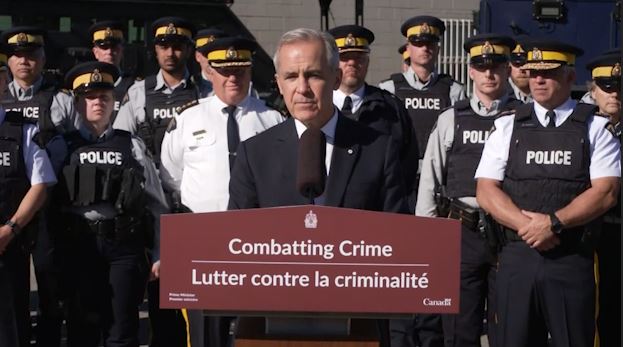
The Liberal government is getting tough on crime as Prime Minister Mark Carney announced sweeping changes to the bail system Thursday.
Those changes include tougher penalties for organized crime and consecutive sentences, so those who are convicted of multiple crimes could spend more time in jail, but not everyone is happy with the proposed changes.
The legislation will be in front of the House of Commons next week and in the meantime, civil liberties groups are hoping to change the prime minister’s mind.
They say his bail reform isn’t grounded in the numbers, and that there’s no evidence that bail increases crimes.
“We’re getting violent criminals and repeat offenders off the streets, full stop,” said Carney.
At an announcement in Etobicoke Thursday, Carney said his government is getting tough on crime.
He’s planning to introduce legislation next week that will make bail more difficult to get for violent and organized crime, including violent auto theft, break and enter, assault and sexual assault.
It’s called “reverse onus” bail, which flips the responsibility onto the accused to prove why they should be let out on bail.
Rather than the current system, that requires the Crown to prove why someone charged should remain behind bars, before their case is tested in court.
“I think it does ease and relieve the minds of victims,” said Joanne Macri, the Director of the Child Victim Witness Program at the Kristen French Advocacy Centre in St. Catharines.
Macri says this change will likely ease a lot of anxiety for victims.
“There tends to be a substantial amount of fear, particularly for witnesses and their families, who have experienced this trauma, and as a result, they now have a fear of bumping into this individual in the community, especially smaller communities,” said Macri.
READ MORE: Both Conservatives and Liberals intend to introduce bail reform legislation this fall
But the Canadian Civil Liberties Association says there’s issues with the proposed policy, as they say many of the similar offences it applies to are on the decline.
“Motor vehicle theft and break and enter are actually down 10 per cent since 2020, and about a third from 2010,” said Shakir Rahim, with the Canadian Civil Liberties Association. “So in our view, it doesn’t really make sense to restrict bail for offences where we don’t see a relationship between bail and those offences increasing.”
The association would like to see the government collect more data about how many offences are committed while the accused is out on bail — currently, there’s no federal tracking on the issue.
Carney’s proposed bill also imposes harsher penalties for organized retail theft, like smash and grab robberies.
It would reverse a current rule that allows some sexual offenders to serve their sentence on house arrest and would allow consecutive sentencing, so someone convicted of multiple crimes would spend longer behind bars.
Meanwhile, the opposition is calling the bill a ‘copy and paste’ of their proposed legislation that was voted down in the house last week.
In a statement posted on X, Conservative Leader Pierre Poilievre said, “That will do nothing because Liberal bail law C-75 requires judges release rampant reoffenders ‘at the earliest opportunity under the least onerous conditions.’ Scrap liberal bail. Lock up criminals.”
We must scrap Liberal bail that frees rampant criminals and has caused a bloodbath in our streets.
Today, Carney refused to scrap Liberal bail, instead repeating the same pledge of a “reverse onus” that Liberals promised 2 years ago in C-48.
That will do nothing because Liberal…
— Pierre Poilievre (@PierrePoilievre) October 16, 2025
Carney also said his government’s fall budget will include funding for 1,000 more Royal Canadian Mounted Police officers and said he will make a major announcement on border security Friday.
READ MORE: City of Brantford calls for stronger scrap metal laws, bail reform