LATEST STORIES:

Hamilton Health Sciences is using state-of-the-art technology to help young patients with neurological conditions and nervous system injuries become more independent.
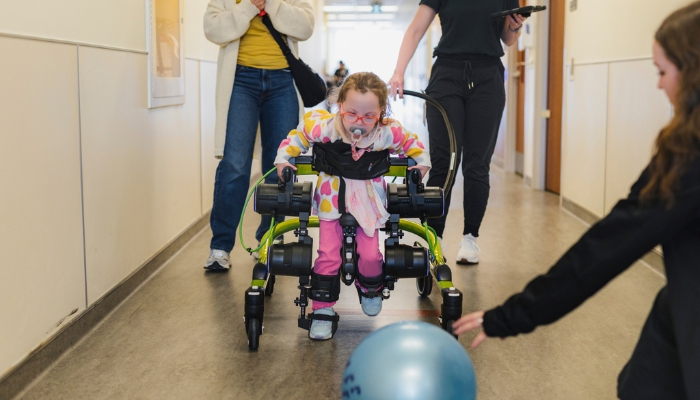
Four-year-old Lily Maracle, who has cerebral palsy, is among those testing out new “robotic legs” as part of a 10-week program at the Ron Joyce Children’s Health Centre.
“She requires assistance with sitting and walking and transferring from spot to spot,” said Lily’s mother, Christal Coates.
As part of her therapy, Lily uses a robotic exoskeleton called the Trexo Plus. Dr. Olivia Ng said the device helps children experience movement and walking while providing clinicians with vital information.
“It’s a neat device because it takes data that gets translated to a tablet so we can see how much a child is initiating their movement, to be able to see how many steps they’re walking, and also how much time that they’re spending in the device,” Ng said.
WATCH MORE: Union says online sign-in at St. Joseph’s Healthcare Hamilton is discriminatory
McMaster Children’s Hospital is the first paediatric hospital to use the Trexo Plus for patient care. Nineteen other children are currently enrolled in the program alongside Lily.
“She gets to be more engaged in therapy and really experiencing that walking movement,” Ng said, adding that the device allows the child to chase bubbles and kick a ball.
Coates said seeing her daughter engage in standard toddler activities has been “wonderful.”
“It’s wonderful because it gives me a vision of what a normal childhood should be like for her,” Coates said. “That was always a question mark for us and still kind of remains a question mark for us of what will she develop into, what are her abilities, her independence in the future five, 10, 15 years from now. But to see that she’s able to do that and engage in standard toddler activities, it’s wonderful. We’re over the moon. We’re happy.”
Ng noted that research shows the Trexo Plus, which costs approximately $100,000, can help with postural control and walking endurance.
Coates said she has already seen the impact at home, where Lily has begun trying to walk while holding her mother’s hands.
“That happened after we started Trexo,” Coates said. “So it’s a really great addition and complements everything else that we’ve done so far.”
WATCH MORE: Hamilton named second-worst Canadian city for seasonal allergies: report