LATEST STORIES:

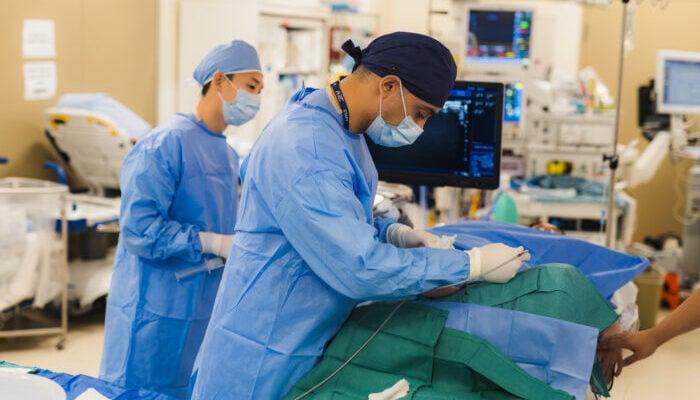
Hamilton General Hospital is the first in the province to offer a treatment that helps with debilitating pain in patients who have had an amputation. While cryoablation is a medical procedure that has been used for years, Hamilton Health Sciences says the technology being used for post-amputation neuroma pain is new.
So far, about 35 patients at Hamilton General Hospital with post-amputation neuroma pain have received the treatment. Neuromas are a thickened bundle of nerve tissue that can form when a nerve is cut.
The treatment has close to an 85 per cent success rate in eliminating or significantly reducing pain and improving daily function.
“The past two procedures that I’ve had, I have noticed a significant change in my pain scale,” said patient Michelle Bisaillon. “So when I was averaging a seven to eight, I was seeing that I was at like a five or a six. And I’m hoping that with now the third one being done that I can get that down even lower.”
Bisaillon tried several different treatments to help her with the pain she has been dealing with for years. After finally trying cryoablation, she is experiencing some relief. She was diagnosed with acute myeloid leukemia at the age of 14 in 2005.
Following cancer treatment, she went septic and her feet went necrotic. After undergoing multiple surgeries, she decided to move forward with a below-the-knee amputation in 2010, and then needed a revision in 2012, which is when she developed three neuromas.
“They’re really painful to touch,” said Dr. Zain Badar, an interventional radiologist at Hamilton Health Sciences. “So when the amputees wear these prostheses, they start to jab on the neuroma and it causes a significant amount of pain that affects their daily life.”
READ MORE: Doctor shortage forces Port Colborne urgent care to adjust hours
Bisaillon says she is always in pain, whether she is in her prosthetic limb or not, so she decided to go with cryoablation. It involves the use of an extremely cold probe that freezes the nerve that is sending pain signals from the amputation site.
The probe is inserted through tiny cuts instead of a large surgical incision, making it possible for patients to usually go home the same day. It is covered by the Ontario Health Insurance Plan (OHIP) and takes only 20 minutes to perform.
“It’s being utilized for treating tumors from the kidney, tumors in the liver, tumors in the lung, as well as tumors in the bones,” Badar said. “Dr. Brad, who’s one of our rehab physicians, approached me and she said, ‘Listen, we need to figure out some sort of treatment for our patients because we’re not having great results.’ And I thought about it and I said, ‘You know what, we’ve used cryoablation in a different setting, so why don’t we take the same concept and bring it over on this part?'”
Badar says it has already helped a number of patients perform their daily activities without pain, like sleeping and grocery shopping.
“Any procedures that we’ve done in the past, I usually get a couple of months relief and then we go through the process again,” Bisaillon said. “The hope with this procedure is that I’ll have a year or two of relief.”
Hamilton Health Sciences has been implementing the treatment for almost a year now. Badar says it is still early and they are continuing to collect data, but they expect patients to have pain relief for about a year before they have to re-treat some of them, since the nerves regenerate.
WATCH MORE: ‘Run for Chris’ raises $40K for Cleghorn Early Intervention Clinic