LATEST STORIES:

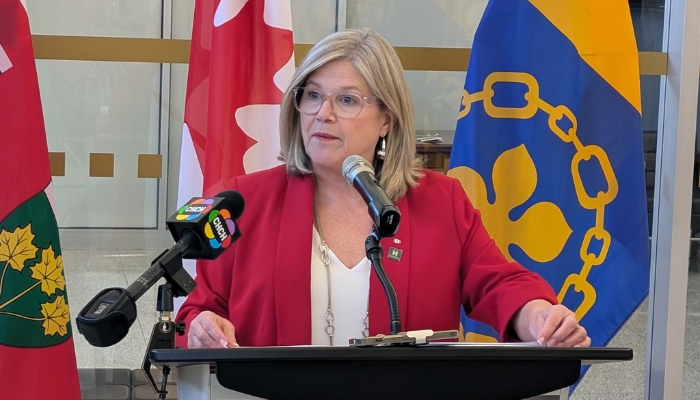
Hamilton Mayor Andrea Horwath told an American audience that trade officials should think about the at-risk families and workers.
In a live interview with CNN, Horwath said Canadian officials are united and that Hamiltonians told her they’re prepared to pivot as both the Carney government and the White house remain at an impasse over a new deal.
This follows after U.S. President Donald Trump signed an executive order to rename Lake Ontario to “Lake America.”
The mayor did not spend much time on Trump’s ongoing provocation, calling Thursday’s announcement “silly name games.”
“What I’m focused on is, is getting people working, making sure that we’re doing everything we can to protect and support our workers,” said Horwath. “I don’t have time for silly name games.”
READ MORE: ‘Then, now and always’: Carney says it will always be Lake Ontario after Trump order
That was what Horwath said on U.S. television on Thursday, briefly responding to Trump and his renaming of Lake Ontario in the United States.
During her interview, the leader at Hamilton City Hall issued a call to the Trump Administration to think about workers and families, impacted by recent tariffs and retaliatory measures on both sides of the border.
However, Horwath conceded that if the Trump administration stays pat on their demands, Canada is united during the trade war.
“Look, we’re hardworking people here in Hamilton — we’re made of steel, really, we are,” said Horwath. “People of Hamilton have been telling me that they’re prepared to weather the pain, because the alternative is not acceptable, and my focus now then, is fighting for our workers to make sure that we have the support from our governments.”
Representing a city that is home to ArcellorMittal Dofasco, Stelco and a wide range of processing steel plants — a steel industry in Hamilton and throughout Canada already hit with tariffs, is set to see more levies come Jan. 1, 2027, according to Trump, which will impact production nationally.
WATCH MORE: Trump signs executive order to rename Lake Ontario to ‘Lake America’
“Where there can be a rupture is actually automotive,” said Peter Warrian, an economist with the University of Toronto. “While you just do the back-of-the-envelope calculation, that could put 25 per cent of the steel that goes in automotive — that could put 25 per cent of the jobs at risk.”
Warrian says it’s tough to gauge exact figures, but billions of dollars flow through Hamilton and southern Ontario alone, and the industry should brace for layoffs.
That’s after the Carney government makes available the $7.5 billion in aid to businesses and workers at risk from Trump’s levies.
“The auto sector is a key consideration for this government, and as well as the steel sector, both are very much present in Ontario,” said Canada’s Industry Minister Mélanie Joly. “While this is all happening, we’ll be smart and we’ll be strategic.”
WATCH MORE: Strike by Hamilton’s National Steel Car workers in seventh day
Prime Minister Mark Carney’s office has yet to say when communication will be initiated with the Trump administration.
While both governments remain at an impasse, due to last-minute disagreements on the deal, key Canadian industries that are not retaliating are ones in potash and energy.
Canada’s premiers are also divided on whether to use domestic natural resources as leverage in talks.
“Do we really want an outcome where the Toronto Pearson Airport no longer has aviation fuel so people can’t fly?,” said Alberta Premier Danielle Smith. “Do we really want people in their homes, working from home because there is no diesel or gasoline to get them to work?”
In Ottawa on Friday, union and industry leaders held a rally, also urging the federal government not to rush back to the table with the U.S.
READ MORE: $385M in OSAP grants sent to students at 7 career colleges last year, documents show