LATEST STORIES:

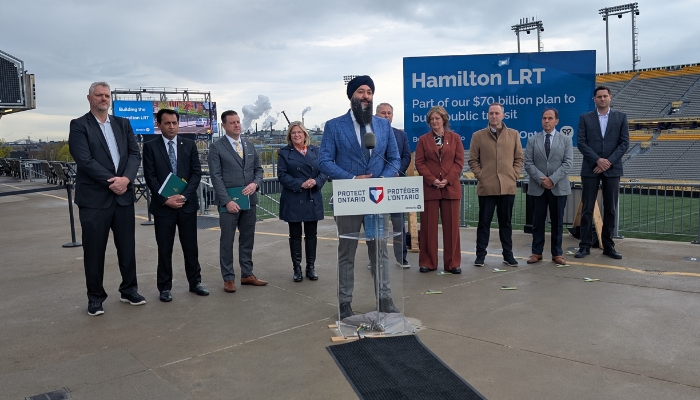
Ontario’s Transportation Minister Prabmeet Sarkaria was in Hamilton Thursday morning announcing a new Light Rail Transit (LRT) Civil and Utilities contract.
The provincial government awarded the first major package of civil and utility work for the city’s LRT project — specifically to Hamilton Transit Alliance, led by Aecon Infrastructure Inc.
The contract is a significant milestone in Ontario’s plan to build affordable transit across the Greater Toronto and Hamilton Area.
The provincial and federal governments are investing up to $3.4 billion — $1.7 billion each — to support the development and construction of Hamilton’s LRT.
“Today we take a significant step towards a new light rail transit line for Hamilton that will support the city’s growth and connect families, workers and students to fast and reliable transit,” said acting minister of infrastructure Todd McCarthy in a statement. “Thanks to Premier Ford’s leadership, our government is investing a historic $70 billion in transit infrastructure as part of our $236 billion capital plan to strengthen communities, keep workers on the job and protect Ontario.”
The contract includes preparatory work along the planned LRT route, including utility relocations, grade separations, road reconstruction and upgraded sidewalks and traffic control systems.
The contract will also advance design work to replace the bridge over Highway 403, build a new LRT underpass beneath the Canadian Pacific Kansas City Hamilton Subdivision near Gage Avenue and improve the Queenston Road bridge over the Red Hill Valley Parkway.
The infrastructure improvements will include:
The City of Hamilton’s LRT project will span across 14 km and potentially create around 6,000 jobs during the construction, and up to 1,000 permanent jobs to support operations and maintenance when the project finishes.
“Today’s contract award announcement is a major milestone for the Hamilton LRT, making it really clear that this long-awaited project is moving forward,” said Hamilton Mayor Andrea Horwath. “To say that I’m happy to be here, I think, is the understatement of my lifetime … I’m thrilled to see the momentum, what it means for Hamilton as we continue to build for the future.”
The rail plans to create reliable transit with stops at McMaster University, Hamilton Stadium, Eastgate Square, Ottawa Street, Gage Park, downtown Hamilton and other spots across the city.
READ MORE: Hamiltonians still in the dark about LRT timelines, despite open house with Metrolinx
The project has been in development for roughly 20 years. To date, the only visible signs of progress have been sewer work and expropriated properties along King Street. For many Hamiltonians, the transit line — designed to connect McMaster University to Stoney Creek — has felt more like a “myth” than a reality.
“When I was in high school in 2014, we all thought it was going to be done in the next year or two,” said one resident. “I kind of think it’s a myth at this point, to be honest.”
However, Mayor Horwath told reporters the time for doubt has passed.
“There should be no skepticism left. There should be absolutely no skepticism left,” Horwath said. “Hamilton is a growing city and growth requires modern infrastructure.”
John-Paul Danko, MP for Hamilton East, added that the project is a “public investment that unlocks billions of dollars in private investment” and will “transform the face of Hamilton.”
Despite the announcement, a specific completion date remains elusive. Metrolinx is suggesting a development phase of up to two years but has not stated when the LRT will be fully operational.
There was also no updated total for the project’s price tag. The most recent construction estimate sits at $3.4 billion, funded by the federal and provincial governments, while the city remains responsible for annual operating costs.
Metrolinx officials noted they are applying lessons learned from Toronto’s Eglinton LRT, which was plagued by a six-year delay and significant budget overruns. The contract announced today represents about half of the Hamilton LRT’s total construction scope, valued at approximately $1.7 billion.
“We’re going to continue to refine ultimately what the real cost of this part of the tender looks like, but it’s roughly half of the size of the project,” said Metrolinx CEO Michael Lindsay.
WATCH MORE: Hamilton city council votes in favour of LRT being privately operated