LATEST STORIES:

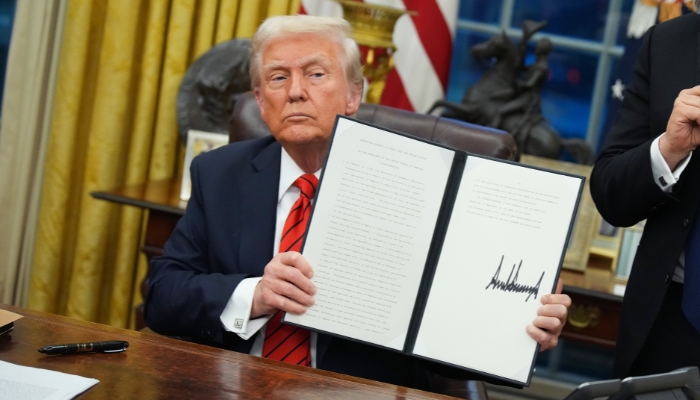
President Donald Trump signed an additional 50 percent tariffs on select Canadian goods on Monday, claiming they’re in response to what he calls Canada’s “acts of discrimination.”
The U.S. leader signed three orders targeting three different industries — the auto industry, the dairy industry and the alcohol industry.
The three presidential actions are dubbed ‘Imposing Duties to Offset Canadian Discrimination Against the Commerce of the United States’ — pursuant to section 338 of the Tariff Act of 1930.
According to the act, a U.S. president can declare new or additional duties in the name of public interest if they find that a foreign country discriminated against the American commerce.
The additional tariffs are set to come into effect less than thirty days from now — on Aug. 19.
In response to President Trump, Prime Minister Mark Carney says the U.S. has been transforming all of its trade relationships including those covered under the United States-Mexico-Canada Agreement.
Carney says Canada has made a “series of detailed and comprehensive proposals to resolve the dispute” and to modernize the trilateral agreement — adding that he “stands ready to intensify those discussions in coming weeks.”
The federal conservatives also released a statement — saying President Trump is wrong to target Canadian workers and must reverse the tariffs immediately. They added that Prime Minister Carney was wrong to “surrender Canada’s leverage for over a year and a half without actually working to secure the deal he promised.”
The new development is expected to be at the top of the agenda at the meeting of Canadian premiers in Prince Edward Island that kicks off today.
Ontario Premier Doug Ford says he’ll never stop fighting to protect Ontario — and that if the tariffs proceed, Canada should respond “tariff for tariff, dollar for dollar.”
Two of President Trump’s acts appear to be tit-for-tat — dairy products for the dairy industry, and alcohol products for the alcohol industry.
But when it comes to the auto industry, the items subject to the new tariffs seem to be a diverse assortment — from agricultural products and plywood to clothing and smartphones.