LATEST STORIES:

The United States is hitting 60 countries with 10 to 12.5 per cent tariffs, including Canada, forcing the federal government to respond to another tariff threat as the countdown continues for 50 per cent levies on a long list of Canadian goods.
The White House says the newest tariffs are meant to tackle forced labour in the global supply chain.
An investigation initiated in March concluded that 60 foreign economies failed to adequately ban or restrict goods made with forced labor, creating unreasonable burdens on U.S. commerce.
The White House Presidential Memorandum directs the U.S. trade representative to impose tariffs and trade measures on these economies under Section 301 of the Trade Act of 1974 due to their failure to effectively prohibit or enforce bans on goods produced with forced labour.
“Finally, we have put our foot down and we have told the countries, ‘You need to take action, you need to prohibit the import of goods made with forced labour and you need to enforce these laws so we have a level playing field,’” says U.S. Trade Representative Jamieson Greer.
“And so we’re taking action to do that and if countries are on the right path, they have a certain level of tariff of about 10 per cent and if they’re not on the right path, it’s a slightly higher tariff of about 12.5 per cent.”
READ MORE: U.S. government hitting Canada, 60+ nations with forced labour tariffs
These new tariffs do not apply to goods compliant under the Canada-U.S.-Mexico Agreement (CUSMA).
In 2020, Canada banned the import of goods made with forced labour to meet CUSMA obligations.
The ban is enforced at ports of entry by the border services agency, where the current framework relies on a “risk-based approach” to identify shipments of goods that may have been produced by forced labour.
In January 2024, the Fighting Against Forced Labour and Child Labour in Supply Chains Act came into effect — a transparency legislation that requires certain entities and federal institutions to annually report on the steps taken to prevent or reduce the risk of forced and child labour in their supply chains.
In April 2025, U.S. President Donald Trump proclaimed “Liberation Day” where he announced sweeping tariffs on almost all of the country’s trading partners.
Trump had relied on the International Emergency Economic Powers Act to declare an emergency to do so.
WATCH MORE: Carney says responding to Trump’s tariffs ‘pressure tactic’ counterproductive at this stage
However, the U.S. Supreme Court struck that down earlier this year, deeming the sweeping levies illegal and ordering them to come to an end by Friday.
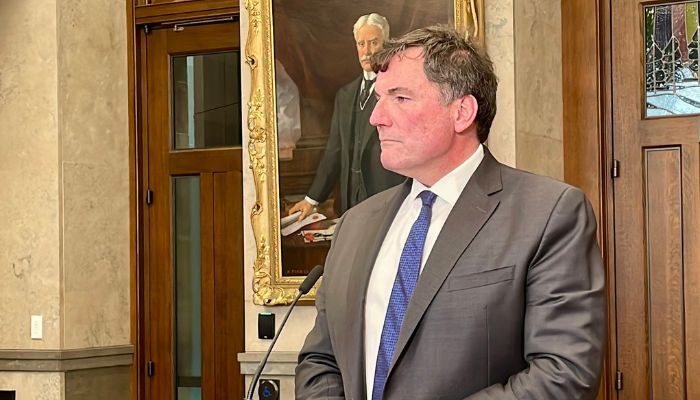
Since that court ruling, the Trump administration has vowed to find alternate ways to impose tariffs, including the recent forced labour tariffs, which Canada-U.S. Trade Minister Dominic LeBlanc says is “not unexpected”.
“Canada shares the United States’ objective of ensuring goods produced with forced labour do not enter our supply chains. That is why Canada has one of the world’s most robust frameworks to prevent and address forced labour, backed by strong legislative and enforcement measures,” says LeBlanc in a statement.
“We continue to strengthen this framework, including through the introduction of new legislation to further enhance enforcement mechanisms last month.”
LeBlanc is referring to a bill introduced by the federal Liberals on June 12 that would replace the country’s current import ban on forced labour goods and establish a stand-alone legislative framework.
Bill C-35 is expected to strengthen Canada’s ban on forced labour by creating a public list of at-risk goods and requiring importers to prove their products are made ethically.
READ MORE: Ford says premiers united ahead of meeting with Carney amid new U.S. tariffs