LATEST STORIES:

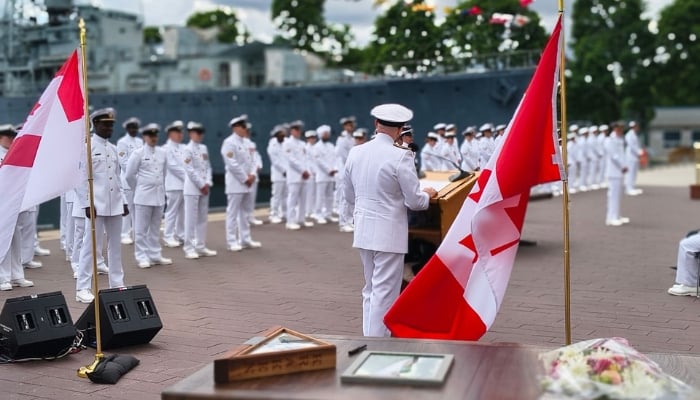
A special ceremony was held in Hamilton this morning to mark the turnover of the commander of the Royal Canadian Navy.
At 51, Vice-Admiral Dan Charlebois says the navy is more important now than it has been in several years. Expanding the fleet and recruiting new sailors will be one of his top priorities.
Charlebois joined the Royal Canadian Navy as a teenager.
“I joined the navy in 1992 in Kingston, Ont., as a 17-year-old. My grandfather served in World War II — he was in the Royal Navy. My mom was a nurse in our navy, my great-grandfather was in the Royal Navy — served in both wars,” Charlebois said.
Thirty-four years later, he has been tasked with commanding the Royal Canadian Navy, taking over for Vice-Admiral Angus Topshee in a ceremony held at HMCS Star in Hamilton Harbour.
“My role will be to continue that great momentum. Last year our navy increased in size for the first time in as long as I can remember. We need to not only increase year-over-year, we need to increase decade-over-decade. Our navy needs to be bigger than it is today,” Charlebois said.
WATCH MORE: Hamilton to begin gathering data to help plan creation of more dog parks
The new commander says it’s vitally important that Canada have a strong navy, given what’s going on in the world.
“This is why we’re undertaking the largest modernization of our navy since the Second World War. We’re building and delivering new ships and we’re going to be doing this for many decades to come,” Charlebois said.
But he says with new ships, the navy needs sailors, so increasing recruitment will be one of his top priorities.
“We’d like to see a navy probably 40 per cent larger than we are today. And that’s just what we need to crew our future fleet with a bit of resilience and robustness,” Charlebois said.
Charlebois says naval reserve divisions, like HMCS Star in Hamilton, will be key to the navy’s future.
“The navy now attracts and recruits through our naval reserve divisions because they have access to parts of Canada where our two fleets that are based on the coast simply do not have access to,” he said.
The Royal Canadian Navy has about 240,000 kilometres of coastline and three oceans to monitor, and right now has about 13,000 members stationed here and around the world.
WATCH MORE: Hamilton school kids help name police force horse