LATEST STORIES:

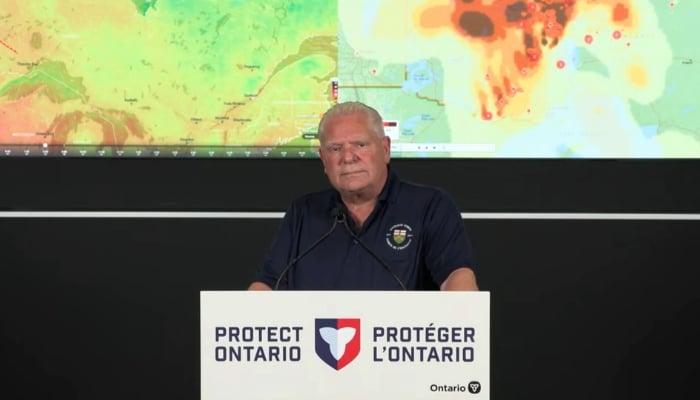
The province says around 190 wildfires continue to burn across northern Ontario, bringing thick smoke to our region for a third straight day.
Communities up north, however, are dealing with more than just smoke.
Indigenous communities have been devastated by the wildfires, but thankfully there have been no fatalities.
Ontario Premier Doug Ford and other provincial officials provided an update on the situation Friday, with Ford praising emergency responders, and rejecting accusations that the province is underfunding the wildfire fight.
“81 are considered not under control, 88 are being observed, 11 are being held and 11 are under control,” said Ford.
Ford gave a sense of the massive and rapidly changing scope of the fires and the efforts to bring them under control.
READ MORE: Trump threatens Canada with increased tariffs due to wildfire smoke
“As of this morning, more than 150 fire crews are on the ground and in the last few days, the number of water bombers and helicopters deployed and operating has risen to over 80, and an additional 39 aircraft are ready to be deployed to the highest needs area,” said Ford. “Our government will not spare a single penny to protect communities and keep people safe.”
However, there has been criticism of the Ford government’s response — some First Nations leaders, including the Collins First Nation, said they had to evacuate residents without help from the province.
“The Collins fire in particular started very, very close to the community — when we were notified, obviously the fire had spread closer to the community at that point, we did our best to mobilize assets to get there,” said Ontario Natural Resources Minister Mike Harris. “That’s what we do in any case.”
Ford made a point to rebuke accusations that the province isn’t doing enough.
“To go out there and try to scare people, and put out blatant lies about the amount of money being spent is absolutely disgusting on their behalf,” said Ford.
In our area, smoke from the northern blazes has prompted air quality warnings.
WATCH MORE: How is Ontario’s wildfire smoke affecting your health?
“Noon today I counted about 53 consecutive hours — we got another 17 hours to go with smoke leading in the forecast, and so probably three straight days of the most fumigating air you could ever deal with,” said David Phillips, a retired senior climatologist with Environment Canada. “There is hope, light at the end of the tunnel so to speak. We see a weather system coming in on Saturday — it’s going to swing through the Great Lakes area, it’s going to bring some wind shifts, different kinds of air mass, some moisture, and some winds that are stronger.”
As for the communities up north, dozens of areas are under evacuation orders with emergency crews focused on saving lives, then property.
But one expert says some property has already been destroyed.
“I would love to see greater priority in Ontario, and the rest of Canada, try to do things before the fire,” said Paul Kovacs, the executive director at the Institute for Catastrophic Loss Reduction. “This is even more education outlook about programs like Fire Smart about how to protect your home.”
Premier Ford also responded to some U.S. officials who wrote a letter criticizing Canada about the wildfire smoke crossing the border.
Ford said they should be focused on sending help, rather than complaining.
READ MORE: Fires from coast to coast: A look at the wildfire situation across the country