LATEST STORIES:

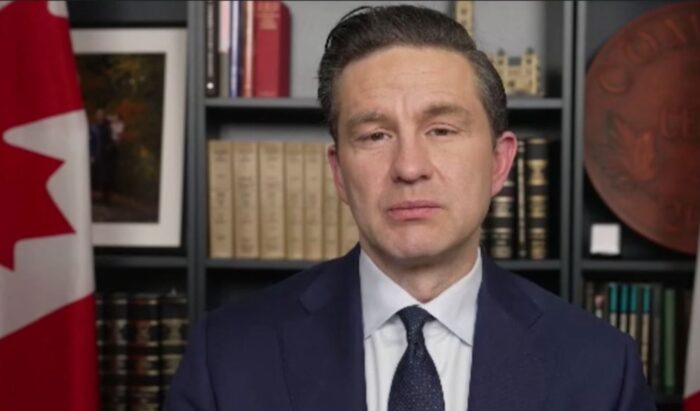
Conservative leader Pierre Poilievre outlined his vision of how he would deal with the Trump administration.
During his speech at the Economic Club of Canada, the Tory signaled that Canada has economic leverage to use in talks with the White House, especially around industries like the auto sector.
Poilievre pointed out that Canada should do away with its EV agreement with China in order to restore free-trade with U.S. President Donald Trump.
“The president’s talk of 51st statehood, whether it’s a joke or not, is unacceptable. It goes without saying, there is zero chance of Canada ever being a part of the United States,” said Poilievre.
Poilievre drew another line in the sand when it comes to Canada’s future with the U.S., but also highlighted a reality.
“Canada cannot control decisions made by foreign leaders or words by foreign presidents. We cannot control what global shocks or volatility might happen. But we do control what we do in our own country,” said Poilievre.
His address at the Economic Club of Canada in Toronto mainly focused on foreign-based trade policies – that includes proposals around how Canada should utilize and leverage its natural resources tied to military defence, and a pitch to reverse a Carney government trade pact with China.
READ MORE: Canadian citizens granted visa-free entry to China
“In short, here’s the deal – we should agree to keep Chinese vehicles out if Americans agree to let Canadian vehicles in,” said Poilievre.
Poilievre says that would be his party’s approach ahead of Ottawa’s review with Trump over the Canada-United States-Mexico trade agreement as a way to try and restore a tariff-free auto deal.
“He also was quite rightly focused on getting rid of taxes for cars that are made here in Canada as well. I think those are the ideas that are going to get more play and more notice when it comes to dealing with CUSMA and other trade relationships with the United States,” said Will Stewart, conservative strategist from Enterprise Canada.
This comes after Carney reached a deal with Beijing to slash tariffs on 49,000 Chinese electric vehicles a year in exchange for China dropping certain levies on agriculture products last month.
The Liberal government continues to seek other avenues to restimulate its auto sector.
Also in January, Ottawa secured a memorandum of understanding with the Republic of Korea, potentially setting the stage for future manufacturing operations on Canadian soil.
“If a Korean company, European company were to come into Canada and build a plant, it would be doing so on the premise that they can sell their excess volume into the U.S. market, the much larger market,” said Brian Kingston, CEO of Canadian Vehicle Manufacturers’ Association
The Canadian Vehicle Manufacturers’ Association noted that last year alone, 90 per cent of vehicles manufactured in Canada were exported south of the border.
WATCH MORE: Carney replaces EV sales mandates with purchase rebates in new auto strategy