LATEST STORIES:

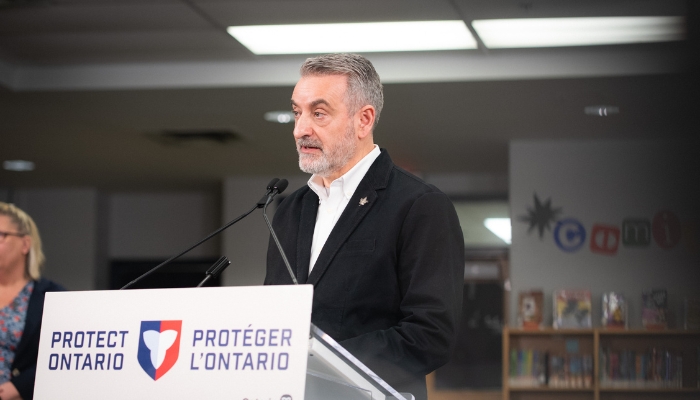
The Ford government says it is time to take cellphones and social media out of the hands of Ontario schoolchildren.
Education Minister Paul Calandra announced tentative plans Tuesday for a complete cellphone and social media ban in schools. While the minister did not provide specific details on the implementation, he joins other provinces and the federal government in arguing that students must be free from high-tech distractions.
Calandra said the well-being of students must come ahead of technology in Ontario, noting that similar restrictions are being proposed or implemented across Canada and as far away as Australia.
“I think the evidence is becoming more and more clear that cellphone use in our schools, elementary and our secondary schools, anywhere on site, has become a problem,” Calandra said.
Ontario is following the lead of Manitoba, which became the first province to ban social media and artificial intelligence for children. Manitoba Premier Wab Kinew said the focus of society should be to train the next generation rather than training the next AI model.
With the federal government also considering a social media ban for children, Calandra said Ontario is looking to expand current school restrictions on cellphones.
“We are considering an outright ban on cellphones on school properties across the province of Ontario,” Calandra said. “Obviously for health reasons we’ll allow some exemptions to that. And we are going to be working closely with the federal government with respect to a broader social media ban, frankly, for kids under a certain age.”
WATCH MORE: Ford government passes budget bill including controversial FOI changes
Technology analyst Ritesh Kotek said that while some restrictions are necessary, students must still remain technologically savvy.
“You’ve gotta understand how to use it safely. When school is out, you’re gonna get these devices back,” Kotek said. “So there has to be that balance. So you want to remove the distractions while ensuring the competencies are appropriately built in, and our students are able to flourish in the real world.”
Atheven Jayakumaran, whose work at an Ancaster clinic includes children’s mental health, said current literature shows attention spans and cognitive processing are “very much impacted” by device use. He added that any new rules must have student buy-in to be effective.
“The kids need to be part of this discussion,” Jayakumaran said. “I also think that we need to not be punitive. We need to learn not to hide these — enforce rules for these kids rather than get them intrinsically involved in the sense where they actually have to have a strong willingness to say ‘Okay. I’m actually going to abide by this, this is going to make sense for me.'”
CHCH News reached out to the education minister’s office for further information on how and when these bans would be implemented, but have not yet received a response.
WATCH MORE: Child advocates rally for online harms bill to cover online gaming, AI chatbots