LATEST STORIES:

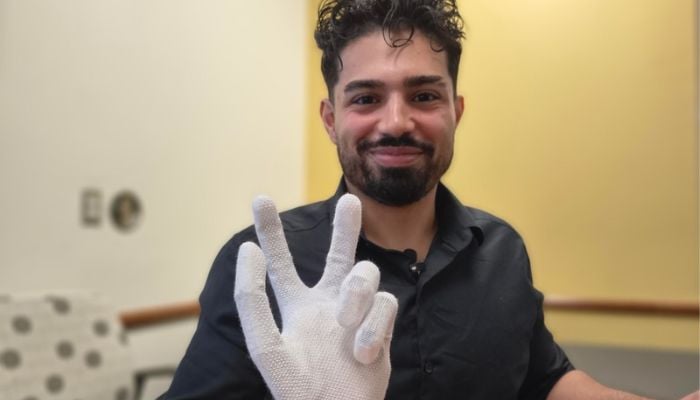
Ahmed Ibrahim and his team at a company called Better Bionics that he started have built a state-of-the-art prosthetic hand with fine motor control in each of the fingers.
“It’s important because when you’re trying to grab a cylindrical object or a ball-shaped object, you have to expand your hand … and no other prosthetic can do this,” says Ibrahim.
When Ahmed was 10 living in Syria he tried building his first prosthetic for his friend Ali, who lost his hand in a bombing.
“As soon as he lost his hand I begged my parents to buy me an RC [remote-control] helicopter and a soldering iron that I didn’t even know how to use. I took the motors out and tried to build him a robotic hand out of those motors, my LEGOs and some strings. It of course failed miserably,” recalls Ibrahim.
But he never stopped trying, and 14 years later has come up the ‘Dream Weaver.’
“Most prosthetic hands — if you can afford the high-end myoelectric prosthetic hands — they have five movements, and that’s to close the fingers, so it’s operating just like a claw. What we’re doing is actually creating a new hand,” says Ibrahim.
The Dream Weaver has 20 different movements thanks to actuators, or motors, that Ahmed built.
Using AI, the hand will sense — and learn — from signals from forearm muscles, so if a person thinks of a movement, the hand will do it.
“The hand itself thinks of how the patient wants to grab, for example, a cup of coffee,” explains Ibrahim.
Ahmed is building the hands at his house in Niagara Falls, a shared lab at McMaster University and the 3D printing room at the Ron Joyce Children’s Health Centre.
“The typical prosthetic — or the previous prosthetic models — were more of a pinch grip, and having a multi-digit articulating hand can allow them to conform the grip around unusually shaped objects,” explains Brad Haardeng of Hamilton Health Sciences.
Ahmed says the Dream Weaver will be part of a pilot project with Hamilton Health Sciences by the end of the year.
Three adults and two children will be using the prosthetic hands.
He’s also applying for regulatory approval from Health Canada.
And eventually he’ll build a hand for his childhood friend Ali.