LATEST STORIES:

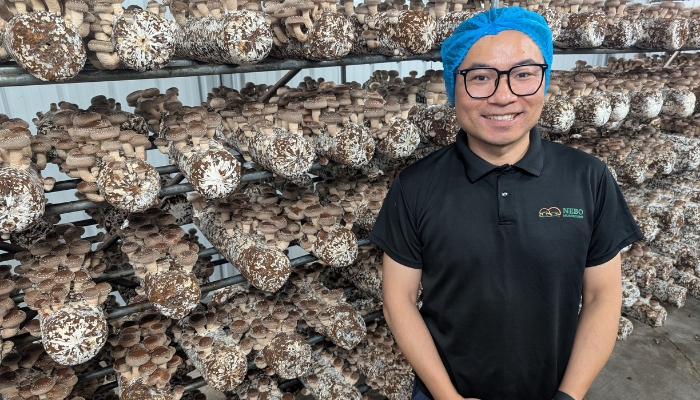
The United States is introducing countervailing duties on fresh mushrooms grown in Canada following an industry investigation.
The U.S. Department of Commerce probe was launched following a complaint from the U.S.-based Fresh Mushrooms Fair Trade Coalition. The group claims that the Canadian practices have led to “lost sales, depressed prices and declining profitability” for U.S. growers.
The change will affect most fresh mushrooms with tariffs of 2.84 per cent, with separate anti-dumping duties expected to be added in a few weeks.
A Hamilton farmer is worried about how the new tariff may hurt his bottom line.
For 11 years, Frank Zhang and his wife, Alice, have raised their children on 100 acres in Mount Hope, growing several varieties of organic mushrooms. But he says a new U.S. tariff on fresh Canadian mushrooms has the potential to reduce his sales, telling CHCH News it has created uncertainty across the supply chain.
Zhang is worried the new 2.84 per cent tariff slapped on his produce by the Americans could lead to a decrease in sales that may even force him to cut back on some of his 22 employees.
“You don’t know how much sales you’re gonna lose,” said Zhang, owner of Nebo Mushrooms Farm. “And you might have to cut some positions if you lose lots of sales.”
The small, organic specialty farm produces only about 2,000 pounds of mushrooms a day for the Canadian and American markets, and Zhang says it doesn’t generate enough revenues to absorb the cost of this new tariff. On top of that, mushroom farmers like him are expecting another charge from the U.S. in the coming months: an anti-dumping duty.
“With this uncertain stuff like tariffs, that’s really something you cannot predict the future,” Zhang said. “That makes lots of stress.”
WATCH MORE: Ottawa, Alberta relations grow stronger as West Coast pipeline agreed upon
Ryan Koeslag from Mushrooms Canada—the national trade association—says because mushrooms are an add-on instead of a centre-of-plate item, Americans will forgo the fungus due to the higher price.
“Ultimately, there will be less people buying mushrooms in the United States,” Koeslag, the executive vice-president of Mushrooms Canada, said. “We might be sending less mushrooms to the United States. It could impact the over 7,000 jobs that we have in Canada in the mushroom industry.”
The 2.84 per cent tariff is a so-called “countervailing duty,” meaning it is intended to offset unfair government subsidies for the mushroom industry. But Koeslag says there is no unfair government subsidization of the Canadian industry, and the U.S. justification is deeply flawed.
“They’ve never moved forward with either one of these types of reasons on a countervail duties,” Koeslag said, noting the Commerce Department is pointing to agricultural accounting practices and tax exemptions that are generally available to farmers as justification.
Canadian mushroom farmers export almost exclusively to the U.S. with the majority of the produce grown in B.C. and Ontario. In 2024, the year-round industry produced over 300-million pounds of the edible fungus, with annual production estimates ranging around $750 million.
Koeslag says Mushrooms Canada is arguing in Washington to remove the countervail duty. The organization is also pushing back against a Commerce Department claim that Canadian producers are dumping mushrooms in the U.S. at a price lower than normal. That claim is expected to result in an anti-dumping duty, further impacting farmers like Zhang in the coming months.
“We have not engaged in those practices,” Koeslag said.
These countervailing and anti-dumping duties are not part of U.S. President Donald Trump’s massive tariff agenda, but Koeslag thinks the pro-tariff agenda is influencing the Commerce Department’s reasoning. He worries a similar approach may be taken against other Canadian agricultural sectors because the bar is low under U.S. law for American producers to allege dumping or unfair subsidization by foreign governments.
Other forms of agriculture and Canadian industry are at risk for additional penalties with the deadline to review the Canada-U.S.-Mexico Agreement (CUSMA) coming July 1.
The Canadian mushroom industry might be able to push back on the countervailing duties under the appeal mechanism through CUSMA.
READ MORE: April Consumer Price Index up by 2.8%, higher gas prices to blame: StatCan