LATEST STORIES:

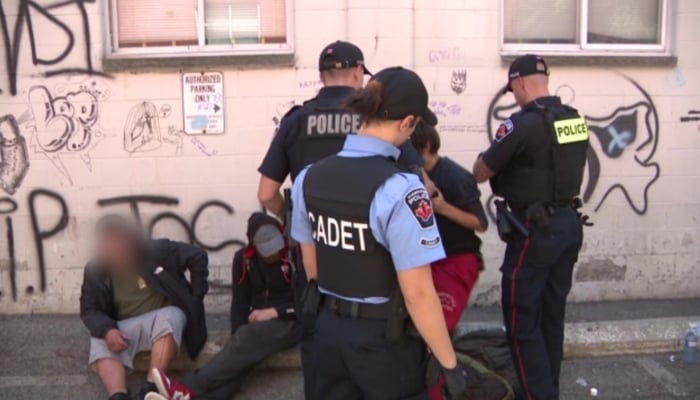
CHCH News follows up on Friday’s story examining Hamilton Police’s downtown core patrol unit, to see how officers address open drug use in the city, in partnership with St. Joseph’s Hospital.
During a walk-along in the city, core patrol officers found Shane smoking out of a pipe.
“You know me, I know you, I always treat you good,” Hamilton Police Const. Sean Giovannini said to Shane. “You have a pipe on you, so you know I’ve gotta search you — make sure there’s nothing else on you. You’ve been through this before.”
Shane was handcuffed, pat down, and read his rights.
“I’m arresting you for CDSA (Controlled Drugs and Substances Act) 401 — it is my duty to inform you you have the right to retain and instruct council without delay,” Giovannini said to Shane.
This was not Shane’s first encounter with core patrol officers.
WATCH MORE: CHCH News examines impact of Hamilton police Core Patrol unit based at downtown substation
“I know Shane very well — I deal with him probably a couple times a day — shane suffers from addiction,” said Giovannini. “If we find anything that would exacerbate the circumstances, that we could add charge, we would go with that. We didn’t find anything, so we seized the pipe, we asked if he would like a RAAM (St. Joseph’s Hospital’s Rapid Access Addiction Medicine Clinic) referral.”
With no aggravating factors, Shane was released.
Partnership between St. Joseph’s Hospital’s Rapid Access Addiction Medicine Clinic and the Hamilton police began last January.
“I think it’s one of necessity,” said Brooke Cowell, the executive VP of St. Joseph’s Clinical Services. “Often police are first-responding to challenges in the community. The benefit of this program is that it allows police to take a healthcare approach and refer to us rather than a criminal one.”
In 2025, Hamilton police began implementing what its new Open Drug Use Initiative, which it says is “a measured compassionate response to public drug use that complies with the CDSA all the while respecting the dignity and rights of those involved.”
WATCH MORE: CHCH News examines typical day for new Hamilton police Core Patrol initiative
At its core, the new policy treats substance abuse as a public health issue, not merely a criminal one.
While public drug use is still an offence under the CDSA, officers are primarily directed to support individuals through education, voluntary treatment referrals, and de-escalation, and to only resort to enforcement when necessary for public safety.
Since July of last year, RAAM saw over 90 referrals made to the clinic by police, seven of whom are currently accessing care.
One person, Bobby, had been offered a RAAM referral by Hamilton police in the past. While he wasn’t ready at the time, he says he is now.
“I wasn’t ready at the time though,” said Bobby. “I was homeless for 22 months. I just want to get clean and go somewhere in life, you know what I mean?”
Lex D’Angelo with the Substance Overdose Prevention and Education Network (SOPEN), says that when working with those suffering from addiction, it’s important to meet the individual where they’re at.
WATCH MORE: Local businesses speak on effectiveness of Hamilton police’s new Core Patrol initiative
“There is a huge mistrust — with the community and with law enforcement,” said D’Angelo.
That is something one policing expert says can be addressed with the right intent.
“When it comes to interacting with marginalized members of the community who can be incredibly vulnerable, but also be people who cause some of the great social disorder, officers need to always be exercising attention to, ‘how do I build legitimacy?’,” said Alana Saulnier, a professor and Canada Research Chair in crime, technology and public policy at the University of Guelph. “An important way that this can be illustrated to someone, is by giving them the opportunity to have a say, have a voice, feel heard.”
“It’s hard to have those conversations, but those conversations, at the end of the day, are going to be the thing that brings us all together and start seeing it from a holistic standpoint, instead of just siloing everything and hoping for the past, and putting many bandaids on a very much bleeding wound,” said D’Angelo.
With the new Jackson Square substation in place, the RAAM clinic says it continues to evaluate how best to serve the community and its vulnerable population, in partnership with Hamilton police.
WATCH MORE: Hamilton police downtown substation opens to respond to community concerns