
LATEST STORIES:

The Liberal government tabled its latest budget on Thursday, its second under Prime Minister Mark Carney.
It comes at a time of ongoing economic uncertainty and continued tariff friction with the U.S.
Thursday’s budget proposes $142.1 billion in new spending or tax breaks.
The government billed this budget as a blueprint for a stronger, more independent, competitive and affordable economy.
Here are some of the key takeaways:
Ottawa is committing to reach four per cent of GDP on military spending this decade and five per cent by 2035.
This moves well beyond the NATO two per cent defence spending baseline.
These commitments begin with $7.6 billion over five years to extend and expand operation reassurance on NATO’s eastern flank to deter Russian aggression.
Also in the budget, a $44.7 billion housing package spread over the next 11 years.
With the goal of expanding non-market housing like non-profit and co-op housing.
The feds claim within a decade the investments can put Canada on a path to end homelessness.
With the ongoing trade war, the government is establishing what it calls a “productivity mega reduction.”
Ottawa is going to lower the Marginal Effective Tax Rate on new business investment from 13 per cent to 6.4 per cent.
It says this will encourage businesses to invest, expand, and increase productivity.
The Carney government is rolling out a one-time, 50 per cent boost to the benefit, putting up to $339 into the pocket of single Canadians and up to $679 for a family of four.
These are just a few of the highlights, but in all the budget commits $142.1 billion in net new measures, with a projected federal deficit landing at $62.3 billion for the 2026-2027 fiscal year.
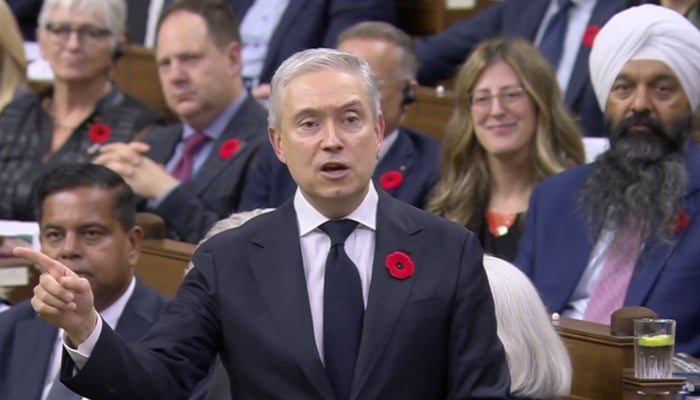
Finance Minister Francois-Phillippe Champagne unveiled the budget at Parliament Hill Thursday, as the opposition made their concerns heard.
At $62 billion, this deficit is actually slightly smaller than what Ottawa projected in the spring, but not by much.
The budget will now move into a multi-week review period where Members of Parliament will debate and eventually vote.
The liberals have a clear runway to push it through, as they have a majority government.
READ MORE: Canadians react after Democrats take control of U.S. Congress