LATEST STORIES:


TORONTO — A question has been swirling in Ontario’s legislature: what happens when terminal cancer patients are told there is nothing more the medical system in the province can do for them, but promising treatments exist that are just out of reach?
Several people with metastatic cancer, previously unknown to each other, have come together to battle for access to drugs either not approved or funded here. They are appealing to the courts to overturn Ontario Health Insurance Plan decisions, and to the politicians in charge on a basic human level.
The patients themselves and opposition critics say the answer to the central question should be an easy one. If there is a medication that can save them, the public system they have contributed to for much of their lives should be able to figure out a way to fund it.
It is unfortunately not that simple, Ontario Health Minister Sylvia Jones suggests.
Jones has come under fire for amending regulations to clarify that out-of-country drug treatments will only be publicly funded in very narrow circumstances, a move that followed a win in court by one of the cancer patients.
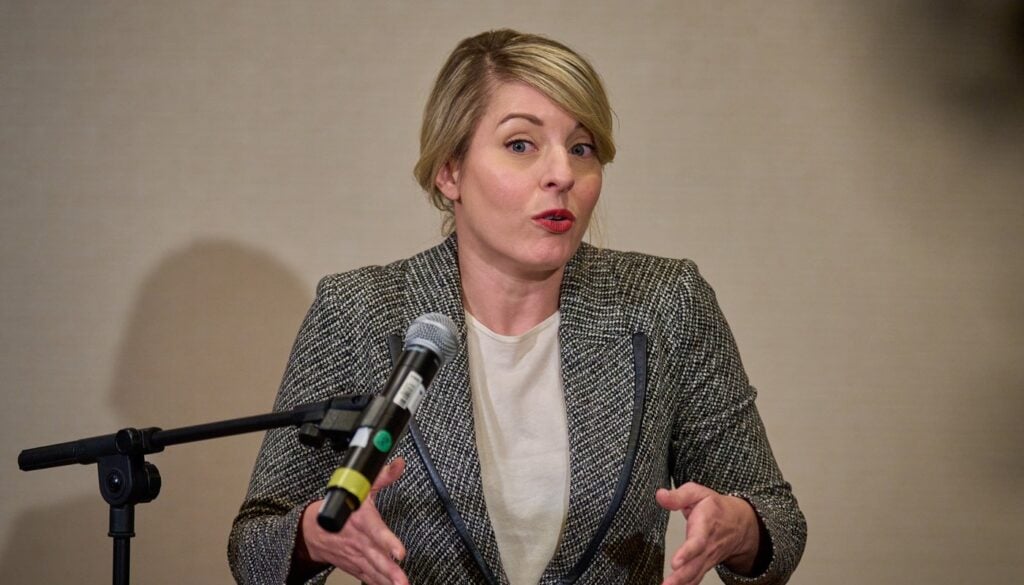
The minister sat down recently with The Canadian Press to discuss the issue in greater detail, as the values and processes underpinning Ontario’s publicly funded health system are confronted with heartbreaking personal stories.
“I think it is fair to say that we all have individuals in our lives who have chased that cure, chased that option, and so I completely understand why they are researching, advocating, trying to find what is out there that is available to them,” Jones said in the interview.
“It is not lost on me. Like I said, I’ve spoken to many families. I can absolutely appreciate why they’re doing it. I guess, I also have a role as the minister of health to make sure that the system continues to be welcoming, encouraging, and available to all Ontario residents.”
The reason for the policy to not fund drug treatments out of country — unless they are already funded here but temporarily unavailable — Jones said, is in part to ensure drug manufacturers can’t circumvent Health Canada’s processes.
After Health Canada’s approval of a drug, there is a clinical assessment by experts that asks questions such as, “Is it for pediatric patients? Is it for seniors? Is it for the entire population?'” she said.
“There are times when people request exceptional access for drugs, primarily, that have been tested and gone through clinical trials for a specific age group, but it hasn’t been tested for another age group,” Jones said.
“Until the pharmaceuticals do that, I don’t think it is government’s role to say, ‘Go ahead and try that. I don’t know if it’s going to work.’ I don’t think that’s our role, and I don’t think it ever should be.”
In the case of Alex Shved, a 37-year-old father of two with Stage 4 melanoma, the tumour-infiltrating lymphocyte therapy his oncologist has recommended is available in the United States at an approximate cost of US$600,000. It has been approved by Health Canada, but the conclusion of the subsequent review and price negotiation process for public funding will likely come too late for Shved.
Ontario has the Funding Accelerated for Specific Treatments program, which speeds up approvals for certain cancer medicines and does contemplate funding in the interim period between Health Canada approval and provincial price negotiations. TIL therapy isn’t part of it.
Shved bristles at Jones’ characterization, which he sees as an implication that patients are asking for fringe treatments, when even the health experts consulted by the government bureaucrats who denied his out-of-country funding supported TIL therapy for him.
“This isn’t about patients reading Facebook posts and wanting to try some experimental drug no one has heard of,” he said.
“These therapies are standard of care in more developed health-care systems and most of the time Canadian doctors are familiar with them.”
In 31-year-old Sabrina Apitz-Grossman’s case, a drug that could treat the rare form of cancer in her knee has been approved by the U.S. Food and Drug Administration, but the manufacturer has said it has no plans to apply for approval in Canada.
As cancer treatments become more personalized, targeted to specific gene mutations of specific types of cancer, Apitz-Grossman said there should be a different way of assessing cases such as hers, where the Canadian market may be too small for companies to bother applying.
“I feel like we all want the same thing, which is we want people to receive treatment, and we want there to be strong options at Princess Margaret (Hospital) and clinical trials,” she said this week after attending question period.
“We want the FAST program to keep operating. That is amazing. But we also probably want a safety net for when those things don’t catch your circumstances.”
Jones said it is “very seldom” that drug companies decline to apply in Canada due to the relatively small market compared to the United States.
“It is very appealing for a drug manufacturer to have their product on OHIP drug formulary,” she said.
She suggested that since a lot of the new, highly targeted therapies are very expensive, those companies should be motivated to go through the process for public funding in Ontario, even if the market is small, because patients are unlikely to be able to afford the drugs out of pocket.
The current system is already well-equipped to deal with precision oncology, Jones said.
“What I worry about is by some nuance in government policy, we actually discourage, or say we actually don’t need to list in Canada because we can get through in a different way,” she said.
“I want all Ontario cancer patients, all Ontario patients to benefit. We shouldn’t need to be looking at expanding an out-of-country process when we have everything here.”
But if we had everything here, the out-of-country program wouldn’t need to exist, Shved said, and he and Apitz-Grossman and others would be receiving potentially life-saving drug therapies here.
“She is just saying, ‘Wait two to three years until the paperwork is signed so we can physically give you the drug here,’ whereas the (out-of-country) program asks, ‘How about we send the most needy patients to get the drug somewhere else in the meantime?'”
This report by The Canadian Press was first published Nov. 25, 2026.
Allison Jones, The Canadian Press