LATEST STORIES:

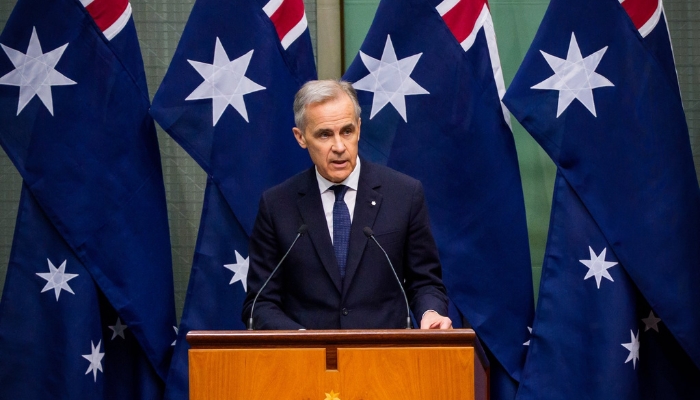
Prime Minister Mark Carney won’t rule out Canadian military involvement in the growing war in the Middle East.
Carney made comments during a joint news conference with the prime minister of Australia after he delivered remarks to the Australian parliament.
The visit to Australia is the second leg of a 10-day trip to the Indo-Pacific, aimed at expanding Canadian ties to other middle-power nations.
“You’ve asked a fundamental hypothetical, in a conflict that can spread very broadly,” said Carney. “So, one can never categorically rule out participation.”
The prime minister gave no indication Canada is planning to join the U.S. war against Iran, but also leaving the door open to action if Canadians need defending or if allies ask for help.
“We will stand by our allies, when it makes sense — we will always stand by and defend our allies when called upon,” said Carney.
Carney differentiated between the preemptive offensive strikes by the U.S. and Israel, and further action taken for other reasons.
WATCH MORE: Local gas stations see prices soar as conflict in Middle East intensifies
During the 2003 war in Iraq, Canada sent navy ships to help with U.S. patrols, but didn’t take part in combat operations.
“I think it’s highly unlikely that we’ll become involved,” said Canada’s former ambassador to Israel Jon Allen.
Allen says Carney is keeping his options open in case a NATO ally is attacked, but even in that case he believes it would be limited to defensive actions.
“I don’t think there’s any appetite amongst Canadians, within the Canadian military or within the government, to get involved in this,” said Allen.
Allen provided an example of where specialized Canadian military assets could be used to evacuate citizens or allies in a dangerous situation.
“That’s a possibility, but again it would be to protect Canadians,” said Allen.
John Kirton, an expert on foreign policy and international relations, agrees the military could be tapped to perform rescues, or to defend allies saying, “there’s several possibilities.”
But he also says they could be sent to defend Canadian troops already deployed in the Middle East on different missions.
“There are already 200 members of the Canadian Armed Forces in the region and if they come under fire and need to be defended or rescued, then more Canadian Forces might have to be deployed,” said Kirton.
WATCH MORE: Canada explores safe passages for nearly 100K citizens in Middle East
Carney’s comments on Iran came after he addressed the Australian parliament — the first Canadian prime minister to do so since 2007.
Bringing the middle-power diplomacy strategy, he laid out, at the world economic forum down under, speaking of the rupture in the rules-based international order.
“With that global architecture now breaking down from consecutive crises, I have come to Australia, at your invitation, to reaffirm our alliance, and to suggest where we can go next,” said Carney.
Carney told lawmakers middle powers like Australia and Canada shouldn’t fight for the favour of great powers like the U.S. or China, but should instead combine strength.
“The world will always be shaped by great powers,” said Carney, “but it can also be shaped by middle powers that trust each other enough and act with speed and purpose.”
Carney touted several new agreements on the trip as an example of the strategic collaboration, instead of competition, that he wants to practice with Australia.
That country joining Canada’s G7 Critical Minerals Production Alliance, which is an effort to diversify and secure critical mineral production and supply.
The two nations are also closing deals on defence cooperation, trade and artificial intelligence.
WATCH MORE: Carney reasserts that global middle powers should band together during Australia visit