LATEST STORIES:

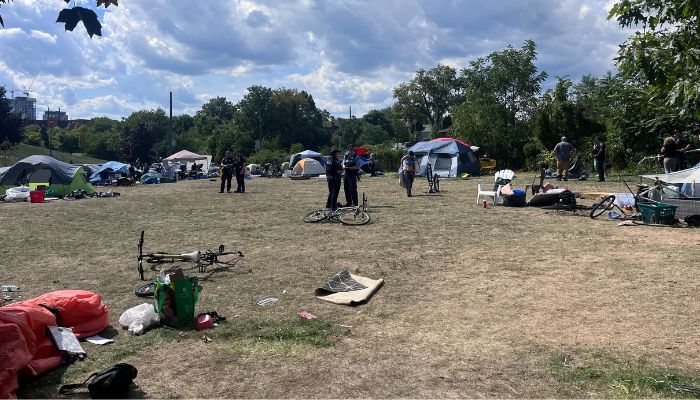
Hamilton’s mayoral candidates will meet on the debate stage once again this evening, this time with a focus on how to tackle housing and homelessness.
It comes as city council is asking for a review of the $130 million they spent on the file this year to see if they got value for their money.
“We’ve been very successful in the City of Hamilton in addressing the housing and homelessness situation,” said incumbent Mayor Andrea Horwath. “Unfortunately, the other orders of government aren’t at the table. And so, the crisis continues to worsen notwithstanding the initiatives we’re undertaking.”
Horwath’s answer came in response to whether she believes staff will find the city’s $130-million contribution to the housing and homelessness budget last year was well spent.
Councillors have asked for a value-for-money audit on the file, and the results will be presented to the next council.
For mayoral candidates Keanin Loomis and Rob Cooper, the answer differs.
“There’s no doubt that we’re spending a lot of money on homelessness and clearly not getting the value,” Loomis said. “We can see it playing out on our streets.”
Cooper saw it differently.
“I’ve met people who have gotten off the streets, their lives have been transformed,” Cooper said. “In those cases, we got a lot of value for money.”
WATCH MORE: ‘Is Hamilton a dangerous city?’: Hamilton mayoral candidates speak on improving local perception
In the last term, the city added 2,100 new affordable housing units, 192 temporary shelter beds, and 80 tiny home spots in the Tiffany-Barton project.
Despite that, the number of people experiencing homelessness has grown from around 1,600 at the start of Horwath’s term to just over 2,000 as of August, according to city data.
“I can say that what we found to be working is the Tiffany-Barton project,” Horwath said.
The mayor says 140 people have used the shelters in the project, and of those, 60 have found permanent housing.
It was slated to close in 2028, but the mayor now says the project will be extended beyond that.
“We’re going to take the resources we currently utilize for pretty much warehousing people in shelters and redirect that to more of the supports, the wrap-around supports that everybody talks about,” Horwath said.
The project was also not without controversy. It went $5 million over budget, for a total of $7.8 million.
“There’s no doubt, there were problems with that project,” Horwath said. “People lost their jobs over those decisions or those mistakes. We now are suing the bad actors in terms of the structures themselves, but the model itself has been very, very successful.”
WATCH MORE: Hamilton mayoral candidates speak on city’s affordability, property taxes
Cooper criticized the handling of the build.
“I talked to an organization last week that said, you know what, they built, I believe it was, 60 portable places for London for $1.6 million and they had kitchens and bathroom facilities, which the ones in Hamilton don’t,” Cooper said. “That’s 100 per cent a procurement problem, and it’s a strong mayor problem. The mayor made a bad call there.”
Cooper said it is too early to tell if he would extend the Tiffany-Barton project, but added that the money budgeted for homeless supports needs to be rearranged to favour supportive housing.
“If people are not delivering outcomes, we will cut them off,” Cooper said. “We’ll give it to organizations that are. And our goal in four years is to have zero homeless in Hamilton.”
Loomis also took aim at city dollars going toward temporary shelter beds over more permanent solutions.
“We know that that is the highest cost per person per day, other than incarceration,” Loomis said. “And we can be doing so much more and better. We have a great example in Mission Services and its move from James Street North to King Street East.”
Loomis is advocating for the Salvation Army’s Booth Centre on York Boulevard to move out of the downtown core—something downtown revitalization group HUPEG has been pushing for.
“We need to move, for example, the Salvation Army,” Loomis said. “That a very important one, one in which our mayor promised to provide leadership and then was nowhere to be found.”
READ MORE: Everything you need to know about Hamilton’s 2026 municipal election