LATEST STORIES:

The Ford government showed a worse than predicted deficit in Thursday’s mini-budget, and a longer path forward until it’s eliminated.
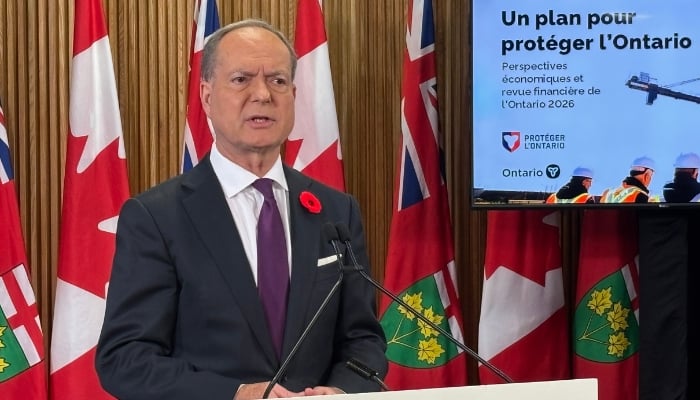
Ontario Finance Minister Peter Bethlenfalvy says this year’s deficit is projected to be $16.9 billion, higher than his initial estimate of $13.8 billion due to economic uncertainty.
The Ontario government says the deficit is projected to be $16.9 billion in 2026–27, $12.7 billion in 2027-28 and $6.7 billion in 2028–29 before returning to balance in 2029–30.
“It’s perhaps the most consequential time in our country’s recent history,” said Bethlenfalvy.
The province gave a snapshot of how Ontario is faring financially, warning that current and impending tariffs, as well as the war in Iran, have taken a greater toll than they initially predicted in the spring.
WATCH MORE: Ontario finance minister to table Fall Economic Statement
“You need to look no further than the price of gas, rising cost of goods due to tariffs, and the impact of uncertainty on investment and employment,” said Bethlenfalvy.
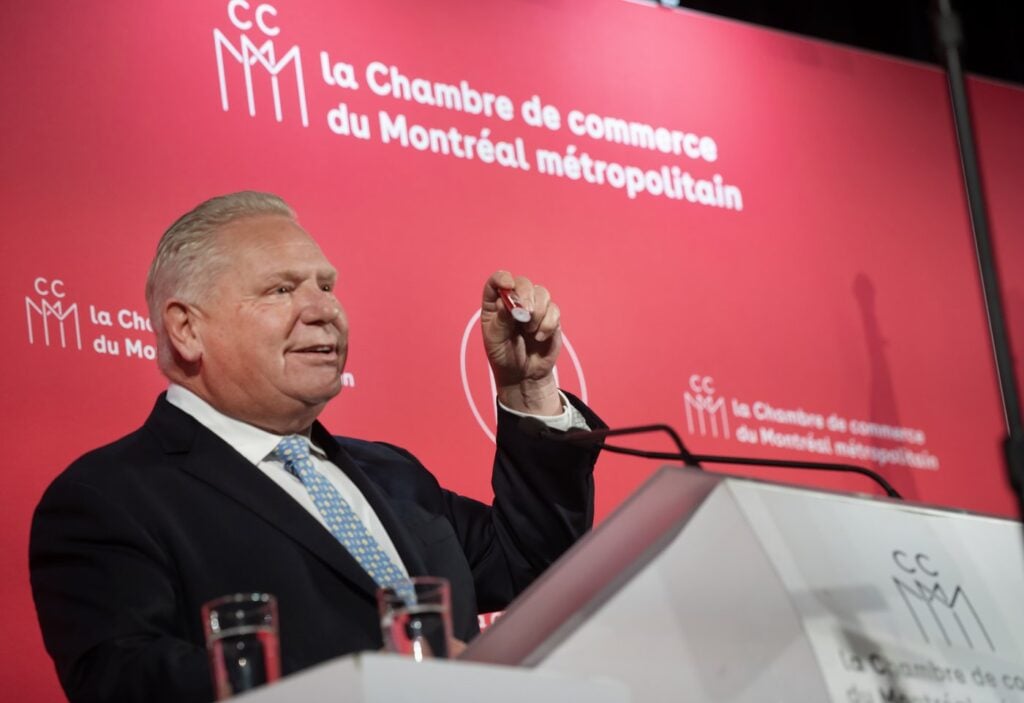
Ontario Premier Doug Ford echoed the sentiment, saying he doesn’t expect much to change following next week’s midterm elections in the United States.
“Even if they lose the house and the senate, the Republicans, I don’t know if anything will change,” said Ford. “We’re going to focus on diversifying our trade.”
Bethlenfalvy released the 2026 Ontario Economic and Fiscal Review: A Plan to Protect Ontario, which government officials say further their plan to protect Ontario workers, businesses and communities while building the most competitive, resilient and self-reliant economy in the G7.
To attract well-paying jobs, the government is investing to protect tariff-affected industries and boost Ontario’s competitiveness across key sectors such as advanced manufacturing, critical minerals, AI and defence.
WATCH MORE: Breaking down interest rates and their impact on your budget
“Ontario continues to face significant economic uncertainty driven by U.S. tariffs on Canada, but our government has a plan to protect workers, businesses and communities while building a stronger economy for the future,” said Bethlenfalvy.
“Through responsible fiscal stewardship we are fortifying key provincial industries as we attract the jobs of the future, protecting key public services and ensuring our province remains competitive in an increasingly uncertain global economy.”
Despite these challenges, the government says Ontario’s fiscal plan maintains the flexibility to respond to changing conditions, while continuing to invest in the priorities that matter most to families and communities and projecting a path to a balanced budget in 2029-30.
This marks the fourth time since 2024 that Ford’s government has pushed its plans to balance the books by a year.
“While I’d like to balance today, I’m also a realist of the world we’re in,” said Bethlenfalvy.
READ MORE: After election victory, Chow to face budget pressure and new deal with Ontario
The government says it will continue to fortify Ontario’s industrial base and attract jobs and investment through the new $8.7 billion Canada-Ontario action plan to strengthen the province’s steel, automotive and critical minerals sectors.
Ontario says it is investing in critical infrastructure through the $210 billion capital plan and maintaining the flexibility needed to respond to evolving economic challenges.
The government says its fiscal plan maintains a sustainable path forward while supporting the long-term growth and competitiveness of Ontario’s economy.
Despite the extra spending, the opposition was not pleased to see a lack of new programs to make life more affordable for Ontarians.
“They plan to grow spending by less than 1 per cent a year,” said Stephanie Bowman, finance critic with the Ontario Liberal Party. “That’s not going to move the needle for families who need help.”
READ MORE: Joly, feds give Stelco owner 15 days to address alleged violations or face legal action
“All of this pain for the people in Ontario and the government still has a deficit that’s going to increase to $17 billion by the end of this year,” said Ontario Green Party Leader Mike Schreiner.
“We would like to see meaningful strings attached to ensure that jobs are protected,” said NDP finance critic Jessica Bell.
CHCH News asked Bethlenfalvy if that money comes with guarantees or workers.
“We’ve been providing support in other measures, like in Hamilton,” said Bethlenfalvy. “Which is working with the municipalities and the unions to address the changes that occur if someone loses their job.”
The Fall Economic Statement also includes housing start projections, and shows starts decreasing slightly this year to 64,700 — down from 65,400 starts in 2025.
The statement projects flat growth for 2027, with increases to 71,700 starts in 2028 and 75,400 starts in 2029.
READ MORE: Ontario matches feds’ tax perk for businesses on capital investments