LATEST STORIES:


The global push back over the Trump administration’s military action in Venezuela reached the United Nations’ (UN) chambers Monday.
The UN’s security counsil called an emergency meeting, where many argued against the White House’s operation — deeming it a breach of international law.
Meanwhile, U.S. President Trump continues to ramp up threats against others, including the Danish territory of Greenland.
“I remain deeply concerned that rules of international law have not been respected with regard to the Jan. 3, military action,” said the UN Secretary-General Antonio Guterres in a statement.
Guterres’ statement was read inside the UN chambers Monday as global leaders responded to the Trump administration’s military action in Venezuela, which many are calling the event a “use of force” and a breach to the UN charter.
“The council must decide if that prohibition is to be upheld or abandoned,” said Jeffrey Sachs, a UN advisor. “Abandoning it would result in consequences of the gravest kind.”
The United Nations’ security council called an emergency meeting to discuss the current instability in Venezuela and the implications of the U.S. raid, when American troops captured president Nicolás Maduro and his wife, Cilia.
“On that day, the Bolivarian Republic of Venezuela was the subject of an armed and illegitimate attack lacking all legal justification by the government of the United States of America,” said Samuel Moncada, Venezuela’s UN ambassador.
Venezuela’s UN representative also took aim at the White House for bombing the country, leaving many dead and major damage to infrastructure.
WATCH MORE: U.S. intervention in Venezuela draws global backlash, local concern
The U.S. continues to defend its case, counter-arguing that the raid was a law enforcement matter, not an invasion. They also claim Maduro is involved in drug trafficking in America.
“As Secretary (Marco) Rubio has said, there is no war against Venezuela or its people,” said Mike Waltz, the U.S. Ambassador to the UN. “We are not occupying a country.”
“Even if there is some ‘fine-tuning’ over the legalities of that approach — meaning the strict law enforcement approach — other states don’t want to allow this to stand, because then everyone is at risk,” said Jane Boulden, a professor of political science at the Royal Military College of Canada
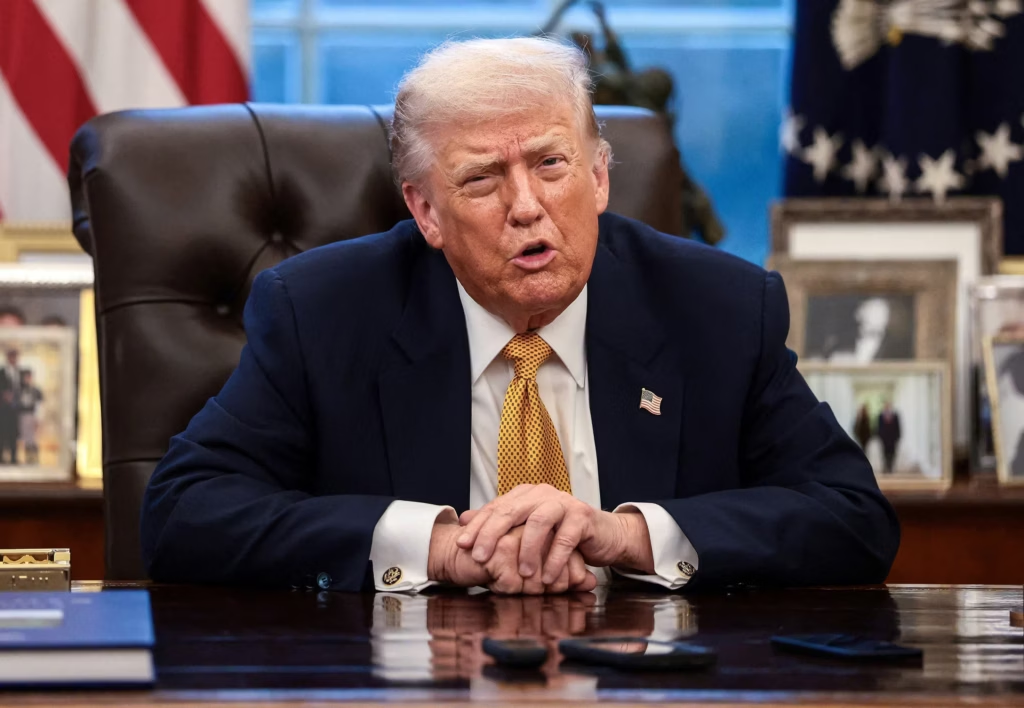
Meanwhile, U.S. President Donald Trump expressed an aggressive approach Sunday, saying the White House is “in charge” of Venezuela, and even acknowledged the country’s vast oil supply.
He also reignited annexation plans in Greenland, citing national security reasons.
Trump continues to argue that an “eastern presence” is in the arctic region, adding that the area sees ships from Russia and China.
Denmark responded saying a move by the U.S. could bring a dark future for NATO. One expert says it’s a bad sign for Canada as well.
“If the U.S. did make a move on Greenland, for us —the world looks completely different, because we (Canada) will be on our own, dealing with the United States,” said Boulden.
“Europe, which is already doing this to some extent, will just turn more inward, to focus on itself and will not be coming to Canada’s assistance.”
Back in Venezuela, Maduro’s vice president, Delcy Rodriguez was sworn in as the interim leader of the country.
She oversaw much of Venezuela’s oil-dependent economy, its intelligence service, and was next in line to succeed Maduro.
WATCH MORE: Experts question legality, consequences of U.S. action in Venezuela