LATEST STORIES:

East Hamilton residents got an important answer on Tuesday about their air quality and the company behind it.
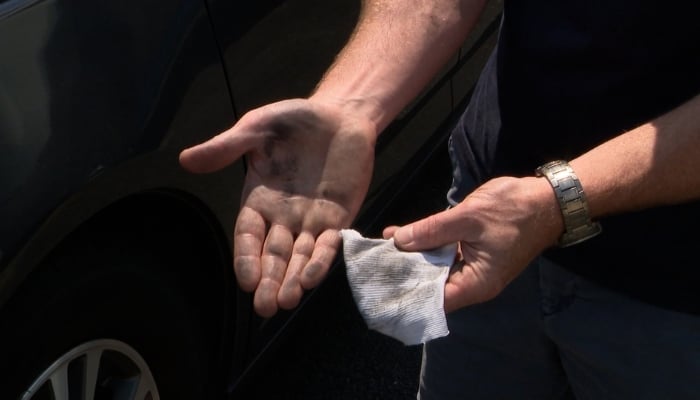
For years, people in the area have been reporting black soot falling from the air.
A new study confirms what they’ve been afraid of — the soot contains toxic chemicals.
Laura LaChance lives in east Hamilton and says she sees it every day: black grime in her yard and on her outdoor furniture not far from Hamilton’s industrial area.
A worse example happened a month ago when the grime was thicker than usual and spread over a wider area of the city to Hamilton Mountain.
WATCH MORE: Ontario NDP leader draws attention to Hamilton’s black soot problem
Laura saved a jar of water from that day.
“If that’s what my water looks, what do my lungs look like?” she asks.
Late Tuesday afternoon CHCH News received a statement from the Ministry of the Environment, Conservation and Parks. It says emissions from a company called Birla Carbon were a “primary source of the reported impacts.”
The statement read that the ministry has referred Birla for formal investigation for “potential violations of Ontario’s environmental laws.”
It will also be requiring the company to take “all necessary action to prevent future incidents.”
In a statement to CHCH News Wednesday, a spokesperson for Birla Carbon says, “Birla Carbon is cooperating fully with the Ontario Ministry of the Environment, Conservation and Parks (MECP); however, the company has not received any communication or copy of the report from MECP with regard to the ministry’s findings.”
WATCH MORE: Boaters, pet owners share worries about unidentified soot in East Hamilton
In the meantime, the public is learning more about grime samples collected in 2024-25.
A study by professor Styler has found at least two toxic chemicals in those samples.
“Our data is supporting things that the community members have already been saying,” says McMaster University chemistry professor Sarah Styler.
“Some of them are carcinogenic, so they cause cancer, some of them are mutagenic, so they can cause genetic damage essentially.”
She says they come from coal combustion, and that there’s more in the grime that should be analyzed.
WATCH MORE: What we know so far about the black soot blanketing East Hamilton
There’s no conclusion about what the chemicals known as PAHS — or polycyclic aromatic hydrocarbons — are doing to people’s health.
“So in terms of calculating the direct health impact one would have to get a sense of how much of the grime people are touching, whether they have hand-to-mouth transfer in the case of little kids for example, and how the load, the amount of PAHS from those sources compared to other types of sources like barbecuing, for example,” says Styler.
“We’re getting questions of ‘How concerned should I be about this?,’ and we’re not quite sure about that yet,” says Environment Hamilton executive director Ian Borsuk.
Environment Hamilton says the emissions keep happening, and it’s time for the provincial environment ministry to act.
“There is public interest and need to act on these fallout emissions and ultimately address what is the grime and how to make it stop,” says Borsuk.
WATCH MORE: East Hamilton residents worry after unidentified soot covers neighbourhoods, families
Candidates in East Hamilton–Stoney Creek’s by-election says residents deserve more information.
“What is in it? Because it’s not just coal and coke. ‘What’s the Grime?’ [Environment Hamilton study] could only find part of it. We need to know how bad is it, how does it affect our health?” says Green Party candidate Pascal Marchand.
“I’ve spoken to a lot of families who’ve been affected by this. They’re terribly concerned about what they’re ingesting, what they’re breathing, what their kids are touching, what they’re walking on, what their pets are getting on their paws,” adds NDP candidate Monique Taylor.
“Our kids shouldn’t be coming home from the playground covered in black soot,” Liberal candidate Heino Doessing said in a statement Wednesday. “Families shouldn’t have their homes and cars covered in a sticky, grimy film, or have to breathe dirty air because they chose to make Hamilton their home. As a father, raising two kids in the east end, I know just how much this has been affecting our residents, it’s affected me too.”
Progressive Conservative candidate Jeff Beattie echoed the environment ministry’s statement, and said he’s committed to protecting Hamilton’s air quality.
READ MORE: Seven local radio stations team up to support Niagara flood victims