
LATEST STORIES:

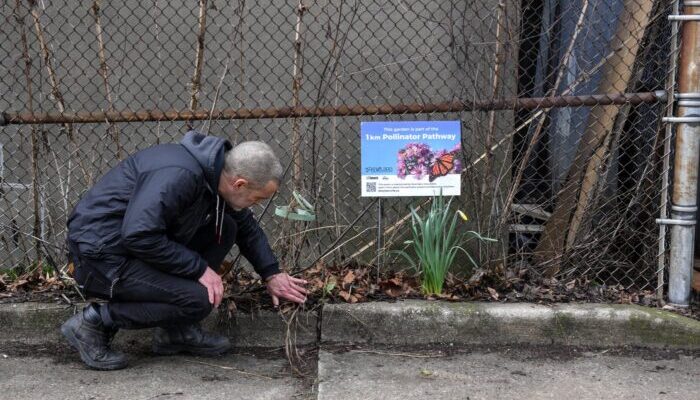
TORONTO — The laneway beside Adam Barnes’s house is, at first blush, unremarkable within Toronto’s catalogue of backstreets: there are garages, a graffiti-tagged brick wall and a chain-link fence topped with barbed wire.
The curb used to be dominated by tree-of-heaven, an invasive plant that can quickly outcompete native species, says Barnes. But when the pandemic turned the laneway into a refuge of outdoor play for Barnes and his daughter, they wondered what other life might grow here too.
Along this concrete stretch, Barnes has helped to recover a number of native plants. Bees, butterflies and other pollinators — pushed to the brink by compounding extinction pressures — now seek out the laneway’s abundance.
Extending between the barbed wire, a towering stalk of a cup plant can serve as overwintering insect habitat. Come summer, its daisy-like flower will attract bees and butterflies, and its cup-shaped leaves will act as nature’s water cooler. In the fall, goldfinches will feed on its seed.
“Nature is taking back over the institution,” Barnes says with a smile as he sits against the curb. Beside him, a mound of little bluestem, a native grass, will soon shake its reddish, straw-like winter hue and take on its blue-green summer colour.
Barnes is part of a growing movement of people and organizations interested in “rewilding” urban spaces. Urban rewilding generally refers to different types of gardens focused mostly — though not exclusively — on a diverse abundance of native plants well-adapted to local conditions and with symbiotic relationships with other species, often formed over millennia.
In one prominent example of that co-evolutionary mingling, milkweed is the essential host plant for monarch butterflies, which are unpalatable to predators because their larvae feed exclusively on the plant’s toxic leaves.
Outside churches, local parks and theatres, dozens of native plant gardens have cropped up in recent years across Toronto with support from the city’s PollinateTO grants, David Suzuki Foundation’s Butterflyway project, and many other community-led initiatives.
Barnes, a relatively novice green thumb and a 46-year-old father of three who worked in the music industry before the pandemic, was entranced by the laneway’s successes. (In peak season, “good luck coming down this laneway and not seeing a monarch,” he said).
He devoured webinars from Project Swallowtail, joined events hosted by David Suzuki Foundation and eventually took horticulture classes at the University Guelph to deepen his knowledge.
He began to notice cracks in the cityscape, derelict spaces where native pollinator habitat could thrive.
What started with one garden has since blossomed into a community project dubbed Rewilders Toronto, supported by a handful of volunteers and city grant money. Barnes has planted more than a dozen gardens around his neighbourhood, and the laneway now forms a segment of a one-kilometre “pollinator pathway,” a stretch of native plant habitat in close enough proximity to allow bees and butterflies to flutter from one to the next.
“It gave me such a wonderful feeling, like a sense of accomplishment, a sense of community, a sense of purpose, and somewhere to put my climate anxiety,” he says.
“I was demonstrating to people that we have ownership over these spaces as a community.”
It might be easy to disregard the significance of a small garden of native plants, especially in a city as big as Toronto. But when connected, they can form an archipelago of refugia across the city’s concrete sea, says professor Nina-Marie Lister.
They create foraging pathways for pollinators and micro habitats for birds and other insects. Native plants are often resilient to local conditions and also boost soil quality. At a time when climate change, driven by the burning of fossil fuels, is fueling more extreme weather, they help to cool our warming cities and soak up stormwater.
They help us feel better too, with numerous studies documenting how urban nature can reduce depression and anxiety.
“These patches, however small they are, contribute to that larger network of ecological services, or what I prefer to call assets, that are connected to life support,” says Lister, a professor of urban planning and ecological design at Toronto Metropolitan University.
“And I think that’s what these folks are trying to do. They’re really engaging with a very small act of care. And care at a time when you know it can sometimes feel like the world is falling apart around us.”
Native plants and pollinators are being pushed to the brink across Canada by a series of compounding pressures, including habitat loss, disease, invasive species and pesticide exposure.
Climate change is accelerating those declines. Warmer, more volatile spring temperatures can put flowering plants and pollinators out of sync, raising the risk of starving pollinators and less pollination. Less reliable snowfall could leave ground-nesting bees more exposed to winter cold. Climate change can also facilitate the spread of invasive species that compete for resources.
It all adds up to a concerning picture: more than one-fifth of pollinator species in North America, and around 10 per cent in Canada, are at risk of extinction. Bees fare the worst, with more than 40 per cent of leafcutters and diggers on the continent facing extinction, a 2025 study reported.
In recognition of those pressures, Toronto now requires developers to use native plants in at least half the landscaping around new builds, with other municipalities introducing similar measures. Yet the Ontario government wants to ban those rules as part of a new housing bill that would roll back municipally-mandated sustainable design standards.
Barnes calls it an unfortunate move, especially when a growing number of people are catching on to the importance of native plants. A 2021 Ontario survey supported by Carolinian Canada found more than half of native plant seed purveyors couldn’t keep up with demand.
“We have an opportunity here in the urban environment to create a nice little network for our native pollinators,” says Barnes.
Along a busy stretch of Bloor Street replete with Korean BBQ restaurants, urban native plant gardens show off their cosmopolitanism. Wild strawberry leaves and bergamot planted by Barnes mingle with daffodils that predate the garden, along with a small tree put in by the nearby yoga studio.
To the east and abutting a parking lot, a medicine garden planted with the Native Youth Resource Centre is nestled in a larger bed dotted with St. John’s-wort and pearly everlasting, a hardy drought-tolerant perennial and host to painted lady butterfly larvae.
To the north, refugee families helped Barnes to lay down a garden in front of the Christie Refugee Welcome Centre, where a chef pulls okra, kale and other vegetables from a community garden out back to help feed those who seek emergency shelter inside.
The Rewilders garden was a “breath of fresh air,” said Denise Hansen, the centre’s family programs co-ordinator.
“It’s so nice when someone is able to come in and say, ‘I have this to offer,’ and it doesn’t even need to be a tangible thing or money or anything like that, but, ‘I have this skill to offer, I’d love to come on this day, I have all this stuff,'” she said.
“It’s really, really refreshing, in the non-profit world.”
Barnes’s efforts have not always been greeted with that same enthusiasm. Two or three gardens have been mowed down over the years and at least one has been filled in with gravel. Barnes has a generous outlook, calling it an “opportunity for education.”
Around the time Barnes was reshaping his laneway, Rhonda Richardson had her eyes on a turf boulevard strip outside her home in Etobicoke.
She ripped out the lawn and replaced it with a variety of flowers but quickly realized some were better for pollinators than others. To learn more, she connected with some local gardening groups, including the Lakeshore Environmental Gardening Society, the group that has for years been rewilding an industrial space outside the Daily Bread Food Bank.
Her search for native seeds took her to a farmers’ market outside Bathurst Station, where she met Barnes. She’s now a volunteer with Rewilders and other groups that have similar missions to boost native plant gardens.
“I’m looking for ways to make a difference and give back as much to the environment, and to just feel less detached and kind of hopeless,” she says.
Like Barnes, Richardson sees opportunities in overlooked corners of the city. She approached the No Frills near her home and offered to plant a pollinator habitat in a neglected patch outside the grocery store.
“It just comes back to a combination of doing what helps me and (what) helps the environment,” she says.
Wednesday marks Earth Day, the global event intended to spur action to support a healthier planet.
It’s good to acknowledge, says Barnes, but he has his reservations.
“One day for Earth Day feels weird,” he said. “Every day is Earth Day.”
This report by The Canadian Press was first published April 22, 2026.
Jordan Omstead, The Canadian Press