LATEST STORIES:

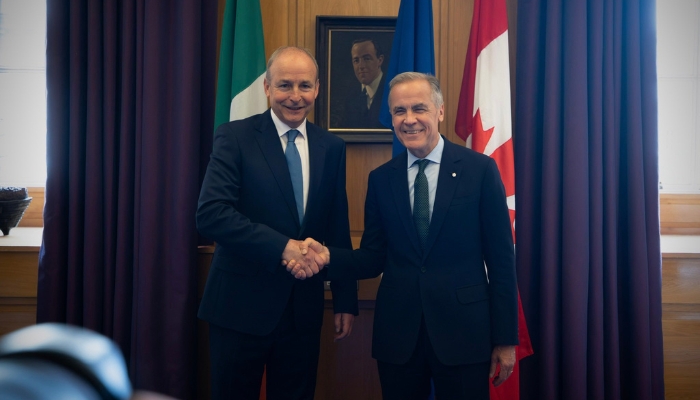
Prime Minister Mark Carney suggested that the ideas of a new world order will be discussed at the upcoming G7 summit.
Ahead of next week’s global conference, Carney made a stop in Ireland today, where an agreement was made on teaming up when it comes to industries like food, pharmaceuticals and artificial intelligence.
Michael Martin, the Prime Minister of Ireland, commented on the alliance.
“Today we agreed a new bilateral cooperation partnership between Ireland and Canada under which we will work together on some of the greatest challenges facing the world,” Martin said.
Carney continued on with his European agenda today, where another pathway to diversification was made in Ireland.
“An analysis led by the government of Ireland suggests that across 13 sectors, from finance to air transport, that through deeper cooperation we can add an additional $2 billion a year in bilateral trade,” Carney said.
Today in Dublin, Carney announced that Canada and Ireland struck an agreement to work together on key issues like pharmaceuticals, food security, artificial intelligence and more. Carney added that cooperation will also include skills development for students and more resources for researchers, as well as a plan to open a regenerative medicine hub in Ireland.
“We’re harnessing complementary strengths to reinforce our sovereignty and deliver benefits for our people,” Carney said.
WATCH MORE: Carney unveils $1B fund to help independent grocers compete with big box stores
Carney’s visit to Ireland is part of a larger six-day trip to Europe, one that sets the stage for the upcoming G7 summit in France next week. Carney suggested the global meeting will be a place where the “strands” of a new world order could be woven — a follow-up from his well-received speech in Davos in January, where he alluded to an alliance of middling powers.
“If you look at the speech, I’ve never advocated that all of sudden there was going to be a band of middle powers,” Carney said yesterday. “We talk in terms of ‘variable geometry.’ So different partnerships with different groups of countries for different issues.”
Peter Graefe, a political scientist at McMaster University, weighed in on the diplomatic strategy.
“At the margins, Canada is putting maybe a bit more effort into building trade relationships with Europe,” Graefe said. “But really, it’s companies that are going to trade, not governments, at least outside of defense procurement. And so, it’s not clear that these are going to make huge differences. It may make it easier for those companies to be able to make these deals without running into red tape and different forms of protection.”
The moves in Europe appear to be signs that Canada is weaning off its decades-long relationship with the U.S.
Ontario Premier Doug Ford released a video about being in the U.S. capital, meeting with industry leaders as the Canada-U.S.-Mexico trade agreement is up for review on July 1.
“We’re in Washington, D.C., meeting with policymakers, business leaders to talk about how we can enhance and grow our economies on both sides of the border,” Ford said in the video.
However, a trade renewal remains in flux after U.S. President Donald Trump downplayed the pact again.
“After six years, it comes up for renewal,” Trump said this week. “I don’t know that I’m going to renew it because to be honest with you, the United States does much better. We don’t need anything that Canada has.”
WATCH MORE: What you need to know about Canada’s proposed under-16 social media ban