LATEST STORIES:

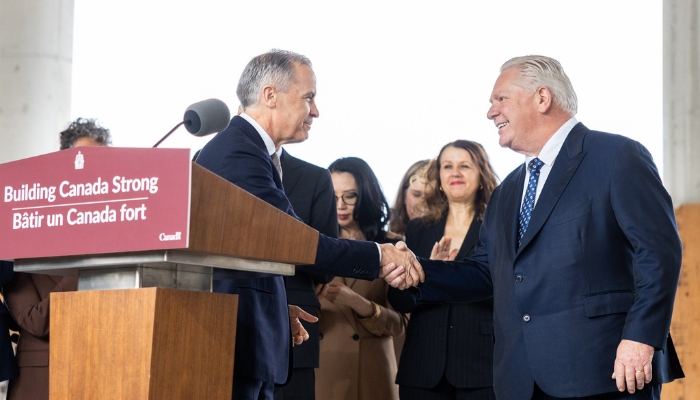
Prime Minister Mark Carney joined Premier Doug Ford and Toronto Mayor Olivia Chow Monday to announce new infrastructure spending to cut costly city development fees.
The prime minister spoke in Toronto unveiling a plan — the Canada-Ontario Partnership to Build — for the province and the federal governments to each spend $4.4 billion on housing-related infrastructure over the next 10 years.
“We’re announcing this new Ontario-Canada partnership to build more homes, lower housing costs, tens of thousands of new careers in the building trades,” said Carney.
This would total to $8.8 billion, a funding deal that is the first to be announced through the federal government’s Build Communities Strong Fund, to be spent to help municipalities cut development charges (DCs) by as much as 50 per cent for the next three years.
“If you don’t cut DCs, you aren’t getting any money, I’ll simplify that,” said Ford. “But if you do, we will be there to support you.”
“By lowering taxes and fees that make new homes more expensive, we can get shovels in the ground and keep the dream of home ownership alive,” said Ford.
As the funding will be distributed across 10 years, Carney said agreements with municipalities will spread the burden of paying for infrastructure out over time, instead of an upfront cost.
The West End Home Builders’ Association says this plan could be a game changer.
“Given how significant development charges are — in Hamilton they can be around $100,000,” said West End Home Builders’ Association CEO Mike Collins-Williams. “A 30-50 per cent reduction here in Hamilton could save that new home buyer $30,000 to 50,000 on a new home.”
WATCH MORE: Ontario plans temporary boost to HST rebates on new homes in bid to energize sector
Hamilton’s Chamber of Commerce says in the middle of a trade war with the U.S., it could boost jobs and the economy in the city.
“It will, in the long term, make our community more affordable — that means people can work and live in our community,” said Hamilton Chamber of Commerce president Greg Dunnett. “It changes the math equation, and that math hasn’t been working for a lot of people and a lot of organizations for the past 18 to 24 months.”
In Burlington, the city has already been providing some from development costs, and Burlington Mayor Marianne Meed Ward said they expect to benefit from the new program as details are worked out.
“This is a good step and this is part of a conversation about how we pay for infrastructure,” said Ward. “It does provide federal and provincial funding for infrastructure that gets housing built in partnership with municipalities and taking some of those costs off the costs of a home, which we need to do.”
Last week, the Ontario government announced a plan to work with the federal government to waive the harmonized sales tax on eligible new builds for the next year.
Both the provincial and federal governments estimate that together, the new agreements will save up to $200,000 in taxes and fees on the cost of a new home.
The Ontario government introduced the Building Homes and Improving Transportation Infrastructure Act, which Municipal Affairs Minister Rob Flack said in a statement is aimed at “tackling red tape, reduce unnecessary costs and streamline approvals.”
The new act, if passed, would reduce gridlock and simplify public transit fares, open up High Occupancy Vehicle (HOV) lanes to more drivers and allow rideshare services in communities along the Northlander corridor.
The federal government then announced a plan to develop a new “GO 2.0” to increase passenger service along freight-owned corridors across the Greater Golden Horseshoe region.
The plan is to support improved service along existing GO lines, and the potential creation of new GO lines.
Ford then said his government was working collaboratively to support the planning and advancement of the Alto High-Speed Rail initiative to connect Toronto and Quebec City.
The premier also mentioned priority transit projects in the Greater Toronto and Hamilton Area, to execute federal contribution agreements including the Ontario Line, Eglinton Crosstown West Extension and the Hamilton LRT.
Along with these announcements, the provincial government said it is looking to expand its One Fare program, to prevent transit riders from being charged another fare when transferring between transit systems in the Greater Toronto Area.
READ MORE: Ontario set to unveil 2026 budget as global conflicts affect economy