LATEST STORIES:

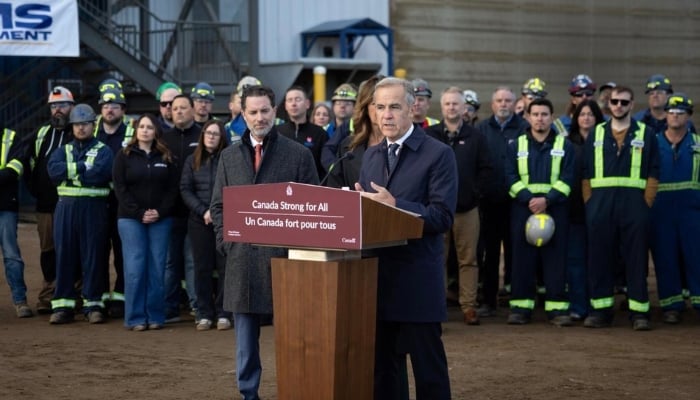
Prime Minister Mark Carney announced a major step Thursday toward a new pipeline for Alberta oil.
He said he’s designated the proposed new pipeline to the west coast as being in the natural interest, the first time that’s been done under his Building Canada Act.
The designation “in the national interest” means the pipeline will be fast-tracked over the next year, and the government will be able to set special conditions that could bypass things like environmental concerns and requirements for consultation with First Nations.
The prime minister made the announcement in Fort McMurray in the heart of Alberta’s oilsands industry.
“The oilsands are part of Canada’s once-in-a-generation opportunity to become a global superpower,” said Carney.
READ MORE: Premiers Smith, Ford unveil proposed west-east oil pipeline route
He says the new pipeline, called the Pacific Link, will run from Alberta across British Columbia to the Vancouver area, following the existing Trans-Mountain Pipeline route.
He says it will carry a million barrels of oil a day, doubling Canada’s exports to Asia, reducing reliance on the United States, and transforming the Canadian economy.
“To create tens, in fact, hundreds of thousands of good jobs,” said Carney. “To unlock the full potential of Canada as a global energy superpower.”
Carney’s experts say the pipeline will cost up to $43 billion, but provide $40 billion a year for the economy.
It will be 90 per cent owned by the governments of Canada and Alberta.
With Alberta facing a vote on separation Oct. 19, both Carney and Alberta Premier Danielle Smith say this supports Canadian federalism.
WATCH MORE: Premiers Ford, Smith propose new ‘Northern Shield’ west-east oil pipeline
“The demonstration of today’s announcement is that Canada is working,” said Carney.
“This is one example, along with the work we’ve done over the last year I think, of demonstrating that co-operative federalism can work in action,” said Smith.
Carney says the pipeline jobs will be created here in Canada.
“We’ll build Canadian — we use Canadian steel with Canadian workers trained by Canadian unions,” said Carney.
McMaster University economic professor Colin Mang says that could mean jobs in Saskatchewan’s steel industry closer to the pipeline, but Hamilton should still benefit from other projects like a proposed Alberta-Ontario pipeline.
“That would be the type of project which Ontario steelmakers would have an advantage in bidding to supply,” said Mang.
Federal NDP Leader Avi Lewis said in a statement that Carney’s Pacific Link pipeline is, “sweeping aside environmental protections, meaningful Indigenous consultation and workers’ right to strike.”
READ MORE: Minimum wage hikes set to begin across five provinces
With only 10 per cent of the project paid for by private industry Pembina Pipeline, University of Toronto researcher Isaac Thornley says environmental issues around Alberta’s oilsands make the pipeline too risky for significant private investment.
“I think it says there’s a great deal of economic uncertainty tied to the long-term future of oilsands and the demand for Canadian bitumen,” said Thornley. “We just can’t predict with certainty that there will be that demand for this relatively high emissions form of crude oil.”
Carney hopes the pipeline will be in operation by 2033.
Conservative Leader Pierre Poilievre says the prime minister should get even more projects built.
British Columbia Premier David Eby says he won’t challenge the pipeline legally, but environmentalists say oil shipments along the coast could threaten salmon, and push the region’s killer whales into extinction.
READ MORE: Alberta, Ontario premiers set to share stage in Calgary to talk energy policy