LATEST STORIES:

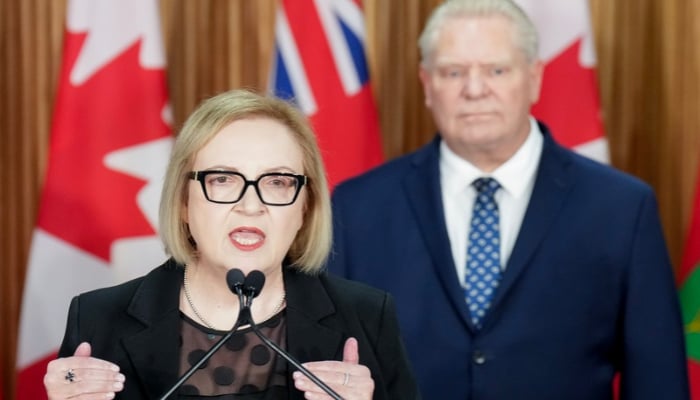
Ontario Premier Doug Ford and Unifor president Lana Payne are calling on Ottawa to exempt automakers from penalties for failing to comply with the government’s tailpipe emission standards.
In a joint statement released Thursday, the two leaders say the penalties will force manufacturers to buy credits from other automakers which do not build in Canada.
“These additional costs are an ‘own goal’ that are helping President Trump achieve his objective of putting every single Canadian autoworker out of a job,” the statement reads.
“Exempting Canadian automakers from non-compliance penalties must come with a firm commitment that automotive production will be preserved in Canada, including a full reversal of the sale of the Stellantis Brampton Assembly Plant.”
The federal government has proposed introducing more stringent tailpipe emission standards to replace its electric vehicle mandate, which it scrapped last year. Last month, Prime Minister Mark Carney said those new standards would be delayed, maintaining the current 2026 standards until at least 2029.
Carney said at the time the move would give Canada’s automakers some breathing room in the face of U.S. tariffs, while helping Canada reach its emission reductions “in the long term.”
The tailpipe emission standards currently in place applies to a manufacturer’s entire fleet. To be compliant, carmakers can either improve fuel efficiency on individual vehicles, or sell more fuel efficient models to offset the sales of less-efficient ones.
“But in the event that you’ve reached the limit of those technological efficiencies, or your fleet does not allow you to achieve the efficiency that is set or the targets that are set by government, there are credits available to allow you to comply,” said Brian Kingston, the head of the Canadian Vehicle Manufacturers’ Association which represents the Canadian divisions of Ford, General Motors, and Stellantis.
“So you purchase credits from another manufacturer that has a surplus.”
Canada has had a fleet emissions credit system since 2010, and began enforcing it since the 2011 model year. Automakers can generate credits when their fleet’s total emissions perform better than what the regulations call for.
While credits earned between 2010 and 2016 could be applied up until model year 2021, credits since then only have a five-year shelf life.
Data published by Environment and Climate Change Canada shows since 2021, Ford and General Motors have purchased by far the most credits among manufacturers, accounting for more than 9 million credit purchases.
The cost to the sector for buying credits is unclear, as those deals are subject to nondisclosure agreements between the manufacturers making them.
However the data shows the vast majority of credit sales since 2021 has come from Tesla, accounting for 12 million. The next closest manufacturer is Toyota at 777,000 credits, followed by Hyundai at 215,000.
In 2024, Tesla sold 2 million credits. The only other manufacturer to sell credits was California-based luxury EV manufacturer Lucid Motors which sold 2,898. Hyundai hasn’t sold credits since 2022 and Toyota since 2021.
GM and Stellantis were the only two manufacturers to buy credits in 2024 — 2 million and 2,898, respectively.
And while manufacturers have been buying credits to get ahead of the more stringent standards Ottawa is introducing — though it’s been delayed until at least 2029 — Kingston said the current regulations make it challenging to automakers to be compliant, especially in the face of U.S. tariffs on the auto sector.
“Government has to continue to take extraordinary actions to support the sector because we have not secured a trade agreement with the Americans,” Kingston said, estimating the cost of tariffs on Canadian manufacturers to be around $8 billion.
“The longer this goes on, the longer we do not have a resolution to our U.S. access problem, the more we’re going to have to look at every element of the Canadian economy and our relative competitiveness.”
Under Ottawa’s now-scrapped EV mandate, companies who weren’t in compliance could make up the difference by investing in charging infrastructure at $20,000 per credit. At the time, Kingston warned it would have cost the industry $3 billion by 2030.
But the tailpipe regulations currently in force only have criminal penalties for non-compliance.
In their joint statement Thursday, Ford and Payne say automakers should offer firm commitments to stay in Canada in exchange for being exempt from penalties.
They are also calling for a “full reversal” of the sale of the Stellantis assembly plant in Brampton, Ont.
This report by The Canadian Press was first published Nov. 26, 2026.