LATEST STORIES:

An art project is taking shape along Niagara Stone Road in Niagara-on-the-Lake, Ont. — one meant to honour the region’s agricultural community and history.
Ron Clavier, a local artist with the Art Gallery of Niagara-on-the-Lake, is spearheading the project, titled “Thanks for the Meal.”
“The drivers of the economy in Niagara-on-the-Lake, always more and above everything else, is going to be agriculture,” Clavier said. “If you’re going to talk about the history of farming, you may as well go back to the first farmers.”
The roadside art installation, named “The Three Sisters,” depicts Indigenous women working in the field. The artwork is created by Indigenous artist Raymond Skye and his protege, Shayde Sandy.
“I wanted, as I said, the artist to be from that community,” Clavier said.
The inspiration for giant farmers originated across the continent in Salinas, Calif., where Clavier saw similar artwork set in local fields.
“I said, ‘What are those?’ They were these giant farmers working, picking up a piece of cabbage or something,” Clavier recalled. “I thought, that’s very cool.”
Clavier contacted California artist John Cerney for advice before bringing the concept to Ontario.
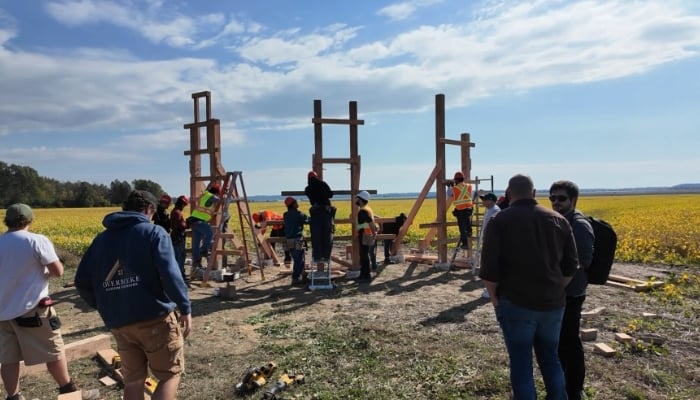
About a dozen Niagara College students constructed the foundation for the installation. Their instructor noted the assignment provided valuable hands-on experience.
“They had to look at blueprints, look at the cut-off list,” said carpentry instructor Nick Fraraccio. “They cut all the pieces up. And, long story short, they’re assembling it right now and they’re doing a great job. They can say, ‘I did that.'”
The artwork is set to be installed within weeks. Clavier hopes the installation encourages meaningful community dialogue moving forward.
“For each culture that will be honoured with this program — the Indigenous folks, the Mennonite folks, the descendants of the British army soldiers who were given land grants, the migrants who come here every year and work their buns off for us to feed us — they don’t know each other, they don’t talk to each other,” Clavier said. “This will help them talk to each other.”
WATCH MORE: Historic Niagara charitable relay race seeks new runners to keep tradition alive