LATEST STORIES:

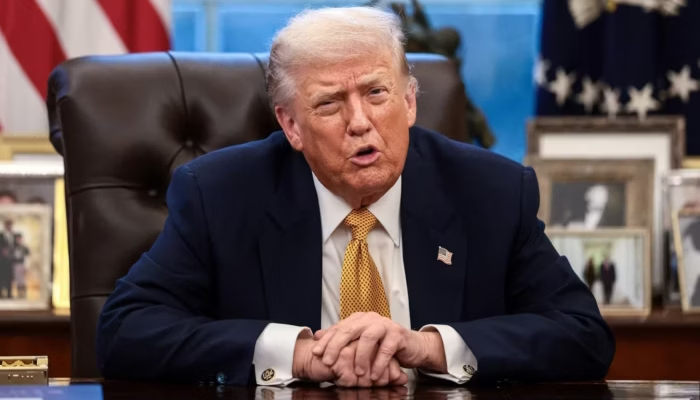
The United States President Donald Trump says the U.S. is working on a deal to buy potash from Belarus, in a bid to reduce dependence on Canadian fertilizer.
In a social media post made Monday morning, Trump said prices would be “substantially less” than what American buyers pay to Canadian exporters.
The president touted the would-be agreement with the authoritarian state, a close Russian ally, as “very good news” for American farmers and ranchers.
Potash prices skyrocketed after Russia invaded Ukraine in 2022, but have come down since, though they remain above pre-war levels.
READ MORE: Ontario threatened to cut off U.S. critical minerals supply. Sudbury isn’t panicking
America relies heavily on Canadian potash, with Saskatchewan-based producer Nutrien Ltd., saying Canada supplies more than 80 per cent of the potash used on U.S. farms.
Natural Resources Canada says the United States imported $4.2 billion worth of potash in 2025, or nearly half of Canada’s potash exports.
While still exempt from U.S. tariffs, potash is a key component in fertilizers.
According to data from the United States Geological Survey, Canada was the top producer of potash last year, leading the list of countries with 15 million metric tons, followed by Russia and China.
READ MORE: Trump’s trade war with Canada is becoming a ballot box issue ahead of U.S. midterms
A professor and research chair in digital agriculture says losing the U.S. could have a huge impact on a number of industries in Canada.
“But what we can see, the major impact what I feel like, if this is going to happen and our trade disruption happened, because if it is 12 million tonne of potash going south, all of a sudden it’s gone down 600 per cent,” said Asim Biswas, a professor and Canada Research Chair in Digital Agriculture.
“That is definitely a surplus of what we’re producing to get those trades, but of course the income coming from that trade, that is going to impact. That means in the past, if the potash is not going to railroads, think about all the societies depending on it. Think about the society or the people involved, and the different levels of that process.”
Biswas added that he doesn’t think Belarus can meet the needs of Americans, and according to reports, the President of Belarus says the country cannot supply potash to the U.S. under Trump’s proposed deal, and that they don’t have those volumes since everything has been sold.
READ MORE: Ontario’s premier: Canada should be ready to cut electricity, critical minerals as trade woes worsen