LATEST STORIES:

(Updated)
A lot of drivers are enjoying the lower prices at the pumps these days. But will they cost our economy more in the long run? The Bank of Canada says the economy is showing signs of a broadening recovery. But low oil prices are a concern. There’s a fear the decline will impact Canada’s oil industry. And Wednesday, Premier Kathleen Wynne met with Alberta’s premier to talk about TransCanada’s proposed energy east pipeline — a $12 billion project that would run through Ontario.
Right now the price of gas is around 1.04 a litre. And some say it will dip below a dollar a litre.
That’s not good news for Alberta which loses more than $200 million in revenue every time the price for West Texas Intermediate crude oil drops by a dollar a barrel. And according to Alberta Premier Jim Prentice, Ontario could also be hurt by a faltering oil industry. All the more reason, they say, to build pipelines.
Premier Wynne: “It’s a little uncomfortable”
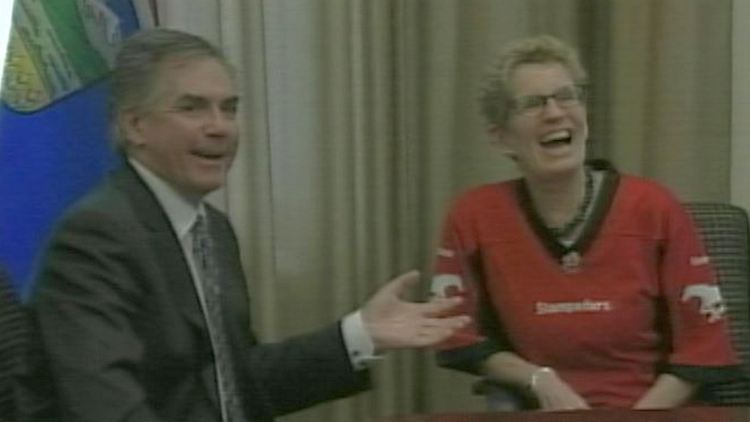
Kathleen Wynne may not be at ease in the winning Grey Cup jersey, but she does share Alberta’s enthusiasm for energy pipelines: “This is about economic development.”
The TransCanada pipeline would be converted to carry crude oil from the west to Ontario. Shown on the map as a blue line, the proposed new stretches of pipeline are in green, and would allow Alberta bitumen to be shipped all the way to refineries in New Brunswick, and ultimately sold overseas.
Jim Prentice says Ontario will benefit as much as Alberta: “Over 11 hundred firms in Ontario are direct suppliers to people in the energy business in Alberta, specifically the oil sands,”
Ontario manufacturers win too. General Electric, for example, will supply the energy east turbines. Prentice says the pipeline is necessary even though fuel is currently cheap: “The premier can’t control international oil prices. What we can do is work to build infrastructure in this country that will allow the western Canadian economy to be connected to global markets. pipelines are part of that, not the only part.”
Ontario’s finance minister Charles Sousa says cheap gas does not hurt this province’s revenues, despite less tax income: “In relative terms, there’s a net benefit to the province that’s how we see this.”
NDP Leader Andrea Horwath wonders why the premier has softened her environmental demands, which are no longer concerned with emissions generated in Alberta: “I think she’s changing her tune today. She has to come clean, what is her position on protecting the environmental interest of Ontario.”
The provinces are trying to have a say in the pipeline projects but really the decisions will be made federally. Only the National Energy Board has jurisdiction to approve the pipelines.