LATEST STORIES:

Confederation concerns appeared to be put to rest after Prime Minister Mark Carney and Alberta Premier Danielle Smith struck an agreement to work towards building a oil pipeline to the country’s west coast.
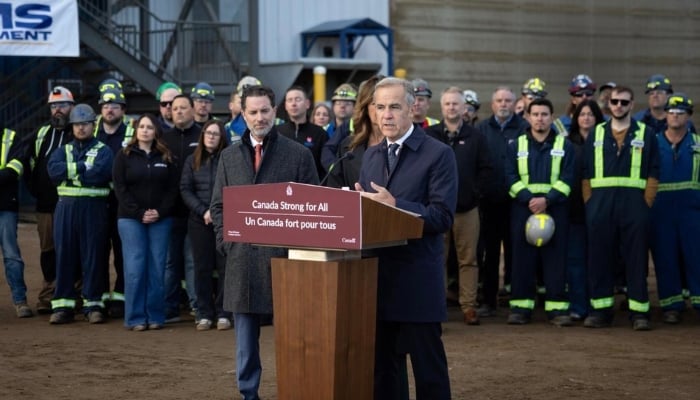
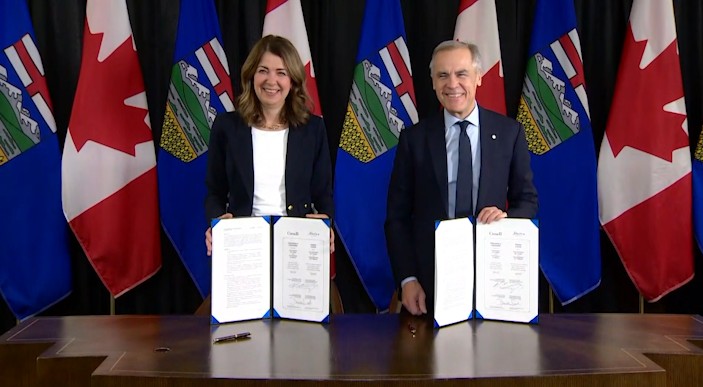
Smith and Carney put pen to paper on a memorandum of understanding in Calgary Thursday afternoon.
Both Carney and Smith expressed optimism about building a framework towards a pipeline, and it took some concessions, like Ottawa addressing certain laws that impact production and Alberta committing to decarbonization efforts.
However, the agreement didn’t sit well with everyone in Canada by Thursday evening.
Confederation concerns appeared to be put to rest after Prime Minister Mark Carney and Alberta Premier Danielle Smith struck an agreement to work towards building an oil pipeline to the country’s west coast.
Smith and Carney put pen to paper on a memorandum of understanding in Calgary Thursday afternoon.
Both Carney and Smith expressed optimism about building a framework towards a pipeline, and it took some concessions, like Ottawa addressing certain laws that impact production and Alberta committing to decarbonization efforts.
However, the agreement didn’t sit well with everyone in Canada by Thursday evening.
A give-and-take agreement was enough to mend fences and re-unify leaders in Alberta and Ottawa after an agreement was made to build a pathway for a new pipeline.
“It’s a framework for building a more competitive, a more independent and more sustainable economies across Alberta and Canada,” said Carney. “Together, we will strengthen federal-provincial collaboration in the energy sector.”
Following the leaders’ signing ceremony, the prime minister made a few stops in Calgary, and addressed the memorandum of understanding, which outlined a framework for a future project intended to export oil to the British Columbia coast and access Asian markets.
READ MORE: Alberta’s Smith supportive of new major projects, says pipeline negotiation ongoing
“The pipeline will transport at least one million barrels of low emission bitumen a day, with a route that reaches new Asian markets as a priority,” said Carney.
In the agreement were some compromises between the leaders, which includes Ottawa altering an oil tanker ban law if the project is fully approved, while Alberta says it will hike the carbon capture price above federal benchmarks.
This follows after years of tension between both governments.
“The government of Justin Trudeau created the independence movement, and my conversations with Prime Minister Mark Carney is that he could end it,” said Smith.
Smith said Thursday that faith has been restored and conditions will work in tandem.
She added that the deal with Ottawa helps create regulatory conditions to attract investment, and while no private company has stepped forward yet, she believes the conditions are laid out for them to buy in.
“We addressed 7 of the 9 bad laws that I put on the table,” said Smith. “I think it will be to the satisfaction of Albertans and I think this will allow us to see substantial investments.”
However, not everyone is pleased with the agreement. Some First Nations communities in B.C. say that a new pipeline to the Pacific coast will never be built and B.C. Premier David Eby called the proposal a “distraction”, adding that it will impact other provincial projects and Indigenous relations.
Carney and Smith confirmed that consultation efforts and equity stake for First Nations are part of the agreement.
The memorandum of understanding says a pipeline project application must be submitted to the major projects office by July 1, while Smith promised to have it ready in the spring.
In response to Thursday’s agreement between Carney and Smith, Canada’s Identity and Culture Minister Steven Guilbeault resigned from Carney’s cabinet.
The longtime activist has been a key fixture in the Liberal government for the past six years, including his role as the environment minister under then Prime Minister Justin Trudeau.
Guilbeault says he will remain as an MP.
READ MORE: Steven Guilbeault resigns from cabinet following Alberta pipeline deal