LATEST STORIES:


Venezuelan President Nicolás Maduro was captured by the United States in a coordinated military operation early Saturday morning.
U.S. military forces extracted Maduro and his wife, Cilia Flores, from their home on a military base in Caracas. Two sources familiar with the incident say they were dragged from their bedroom.
American forces then flew Maduro and his wife out of the country to an American warship. From there, Maduro and his wife were put on a plane bound for New York where they are set to face narco-terrorism charges.
Along with the capture of the Venezuelan president and his wife, the U.S. also launched multiple missile attacks.
This strike on Venezuelan leadership comes after months of increased pressure from the Trump administration on the oil-rich nation.
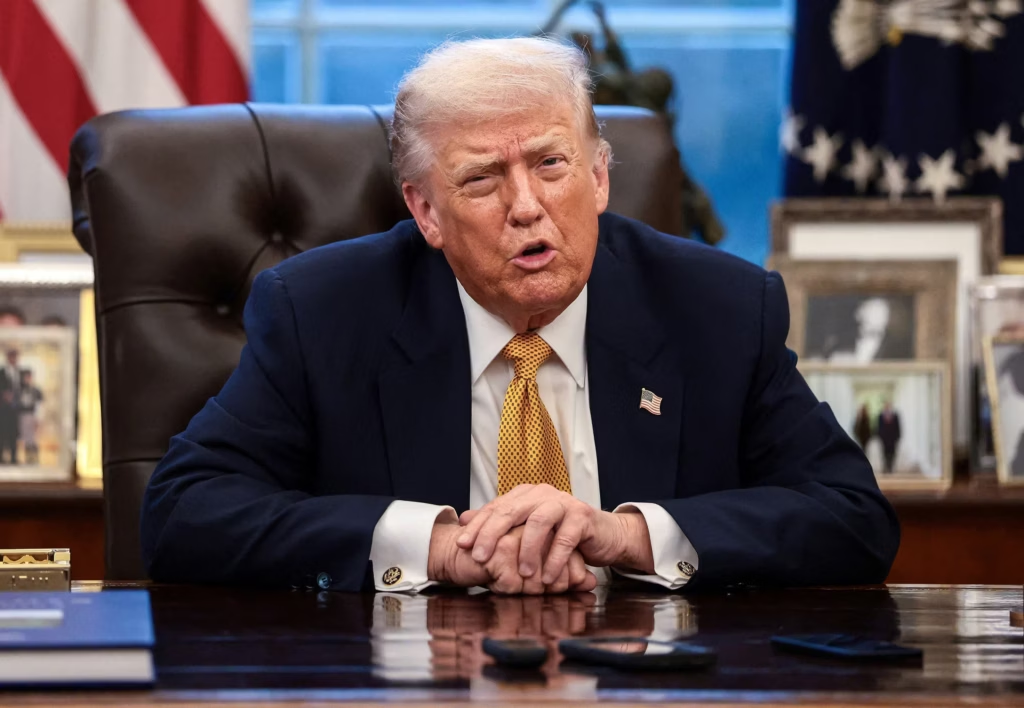
President Donald Trump says the United States plans to oversee Venezuela until a transition of power happens.
Trump took to his social media platform, Truth Social, to post a photo of the captured Venezuelan leader.
Nicolas Maduro on board the USS Iwo Jima.
(TS: 03 Jan 11:23 ET) pic.twitter.com/uHWmcm3K2V
— Commentary: Trump Truth Social Posts On X (@TrumpTruthOnX) January 3, 2026
In a statement released by Canadian Foreign Affairs Minister Anita Anand, the federal government is calling “on all parties to respect international law.”
Anand went on to say that Canada has “refused to recognize any legitimacy of the Maduro regime and opposes its repression of the Venezuelan people.”
Canada has maintained this position since 2019, when it closed its embassy in the South American country.
WATCH MORE: María Corina Machado wins Nobel Peace Prize. Why is the White House upset?
Political experts locally say despite Trump’s bravado, this isn’t a positive move for the Venezuelan people.
“This is not a defence of Maduro, this is about pushing back against a very dangerous precedent — which is that the United States will act militarily regardless of any sort of legal, diplomatic or geopolitical norm,” said Don Kingsbury, a political science professor from the University of Toronto.
“Canada, Greenland and Panama – we have all been in the crosshairs for Trump already. And I think this is an indication of just how far Trump is willing to go to completely violate other countries’ sovereignty in the western hemisphere,” said Stefan Dolgert, a political science professor from Brock University.
Dolgert says the recent attacks on Venezuelan drug boats was just a smoke screen of sorts to distract people from what Trump really wanted.
“So clearly the oil is one of the big important things. Trump is indicating, basically, the U.S. is going to take control of Venezuela’s oil. He’s saying that openly. The other big thing that this does is it serves to distract from the Epstein files and from a whole bunch of other domestic problems that Trump has,” said Dolgert.
“His popularity is plummeting. This is a classic wag-the-dog scenario of – start a kind of foreign war or foreign conflict in order to – hope that people rally around the flag.”
Kingsbury says there are still too many unanswered questions, but right now he doesn’t see any positives for the Venezuelan people.
“The Venezuelan people are not going to benefit from this. We’re going to see a sell-off of national industry, potentially. We’re going to see Venezuela used as a pawn in the United States’ geopolitical chess game between the U.S., China and Russia. And really, it’s the majority of Venezuelan people that are going to continue to suffer,” said Kingsbury.
American Secretary of State Marco Rubio is hinting that Cuba could be the next target of the Trump administration’s push to restore American dominance in the Western Hemisphere.
Canada has issued a travel-advisory for Venezuela, saying to avoid all travel to the South American country due to “the significant level of violent crime, the unstable political and economic situations, the risk of arbitrary detention and the decline in basic living conditions — including shortages of medications, gasoline and water.”
WATCH MORE: Trump, Iran exchange warnings amid widening economic protests