LATEST STORIES:

With six months to go until the 2026 FIFA World Cup kicks off, tournament organizers in Canada say they’re proud of the work that’s been done — and that there’s still a lot to go.
Vancouver is set to host seven games during the expanded tournament, while Toronto will stage six, including Canada’s first group stage match on June 12.
Both cities have been busy renovating stadiums, creating plans to accommodate a massive influx of visitors and drawing up policies to ensure visitors and residents are safe.
“I don’t know if anyone’s ready to host a tournament right now, to be honest with you,” Peter Montopoli, Canada’s chief tournament officer, said this week.
“I think we’ve done the work, but now it gets into stadium preparedness. … We’ll be ready, but I’m not sure anybody’s really ready to do the World Cup today.”
The World Cup will begin June 11 with games in Mexico City and Guadalajara, and run through July 19 when the championship matchup is held in East Rutherford, N.J.
Sixteen cities across Canada, the United States and Mexico will host the 104 games, though they won’t learn until Friday’s final draw which of the 48 countries will be playing in their stadiums.
Toronto has adopted the slogan “The World in a City” as it gets set to welcome soccer fans from around the globe.
“We really feel like whatever countries land here … they will have a home crowd here in Toronto, and there will be neighbourhoods celebrating all over this city,” said Sharon Bollenbach, the city’s executive director for the tournament.
“We want folks coming here from all over the world to feel at home and to be visiting these neighbourhoods and really see a city that’s living together with such a diverse culture.”
The cost of hosting six games in Toronto has been pegged at $380 million. The federal government is expected to contribute $104 million while the province chips in $97 million. The city will pick up 47 per cent of the total price tag — around $178.7 million.
Organizers are “holding firm” to the $380-million budget, Bollenbach said.
“Obviously, like any big event, there’s things that may have gone over budget, but we’ve been found savings in other areas,” she said.
Part of the cost is a $146-million renovation of BMO Field. The city will pay $123 million for the upgrades, while Maple Leaf Sports and Entertainment — which manages the city-owned facility — will put in $23 million.
The first phase of the facelift included the installation of new video boards in each of the stadium’s four corners and improvements to the sound, lighting and WiFi. Some hospitality suites also got an upgrade, and a new lounge was added.
That work all wrapped in September as Toronto FC and the Toronto Argonauts wound down their seasons.
Now a new phase is underway — work that couldn’t be done with teams in the building, Bollenbach said.
The biggest piece of the current renovations is the addition of 17,000 temporary seats that will bring BMO Field’s capacity up to the FIFA minimum of 45,000.
Work is also underway at Centennial Park in Etobicoke, where teams will train ahead of their games in Toronto.
The field looks great, Bollenbach said, and construction is underway on the field house.
“That venue will be used by the community after the World Cup is over,” she said. “So, excited to be taking something that’s legacy outside of the downtown core of Toronto and a little farther out from the downtown, and have a community sort of in the suburbs be able to benefit from the World Cup investment as well.”
Work also continues on how the city will manage the thousands of fans expected to flood in from around the world next summer.
Once FIFA releases its match schedule following Friday’s final draw, fine-tuning will be done on traffic management plans, including the improvement and addition of transit service to help manage the flow of people in and out of the downtown core, Bollenbach said.
Last summer, some city staff went to large-scale soccer games in Europe to get a better idea of what to expect from fans, she added.
“We have some great, great experience from big events here in Toronto. But to really kind of see a soccer experience is different, right? The patterns of soccer fans are very different than other fans that might be going to a concert or other event.”
Work also continues in Vancouver, which will host its first game on June 13.
“It’s starting to feel like Vancouver is starting to understand truly how big a deal this is and what it’s going to mean,” said Chris May, general manager of B.C. Place, where the games will be played. “And I’m starting to feel more around the community and the city that people are just talking about it.”
The city announced a series of new bylaws last week that will increase noise limits, speed up the process for removing graffiti, and allow for temporary fan zones and structures in some areas from mid-May through late July.
The B.C. government said in June that the cost of staging seven games will be between $532 million and $624 million, including up to $196 million to upgrade B.C. Place.
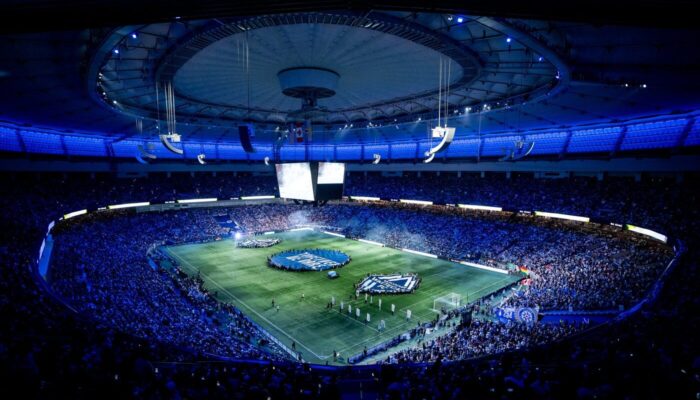
Opened in 1983, the 55,000-seat facility is owned and operated by PavCo, a provincial Crown corporation, and has already hosted large-scale events including the 2010 Olympic opening and closing ceremonies, the 2015 FIFA Women’s World Cup and the final three dates of Taylor Swift’s Eras Tour.
Construction has long been underway throughout the downtown stadium, including upgrades to locker rooms, lighting and hospitality areas.
“Things are on schedule at this point,” May said, adding that management opted not to fill the building’s winter calendar in order to make sure work got done on time. “We made a tactical decision to not take in a lot of events sort of from mid-December until mid-February.”
Over the next several months, a new scoreboard will be installed, and three new elevators will help increase the building’s accessibility.
“If you’ve ever needed to use an elevator here when the building’s full, or you’ve ever been with someone that’s travelling an accessible journey, bluntly, it’s not a great experience,” May said. “And I’m really excited that those three new elevators are going to come in and provide a lot more circulation within the building.”
A temporary grass field will also be installed ahead of the tournament.
The grass is currently being grown in the Fraser Valley just outside of Vancouver and construction will begin on April 26 — the day after the Vancouver Whitecaps host the Colorado Rapids in their final home game before the World Cup break.
Putting the field in will be a three-week-long process. The grass will then grow for another three to four weeks before the first game is played.
While each city has its own preparations underway, organizers are also working on plans for the country as a whole — including safety and security during the tournament.
Many of those plans won’t be made public, Montopoli said, but officials from every level of government have been working on them for several years.
— With files from Neil Davidson.
This report by The Canadian Press was first published Dec. 3, 2025.
Gemma Karstens-Smith, The Canadian Press